EXECUTIVE SUMMARY
India's services sector contributed 56.40% of Gross Value Added (GVA) in 2025-26, up from around 51% in 2013-14, and grew 9.10% during the year. Services exports reached US$ 418.31 billion, while the sector remained India's largest recipient of Foreign Direct Investment (FDI), attracting US$ 128.85 billion cumulatively.

Services GVA Share (FY26)
56.40%

Services Exports (FY26)
US$ 418.31B

Cumulative FDI (2001-26)
US$ 128.85B

Services Sector Growth (FY26)
9.10%
Introduction
India's services sector spans trade, repair, hotels and restaurants; transport, storage, communication and broadcasting-related services; financial services; real estate and professional services; and public administration, defence and other services, encompassing sub-sectors such as IT and IT-enabled Services (IT-ITeS), banking and financial services, telecommunications, healthcare, tourism and hospitality, and education.
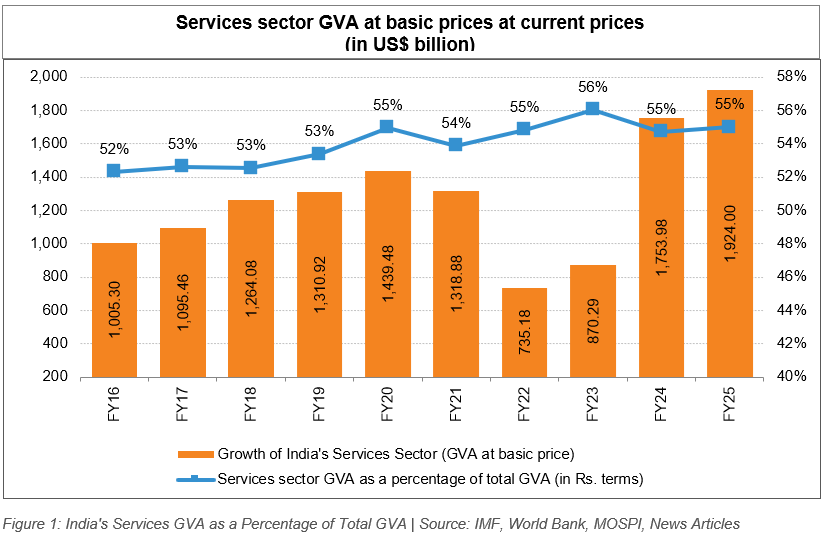
The sector has emerged as the principal engine of India's economic growth, with its share of Gross Value Added (GVA) rising steadily over the past decade. India has become the world's seventh-largest exporter of services, with its share of global services trade more than doubling from 2% in 2005 to 4.30% in 2024.
The services sector employs about 182 million people, generating nearly three jobs for every one created in manufacturing, and remains the top recipient of Foreign Direct Investment (FDI) in the country. Sustained digital adoption, expanding Global Capability Centres (GCCs), and deepening trade agreements continue to reinforce the sector's role as a key pillar of India's ambition to become a developed economy by 2047.
MARKET SIZE AND GROWTH
- India's services sector is estimated to have grown 9.10% in FY26, up from 7.20% in FY25, with its share of GVA reaching a historic high of 56.40%, and its share of Gross Domestic Product (GDP) rising to 53.60% in H1 FY26.
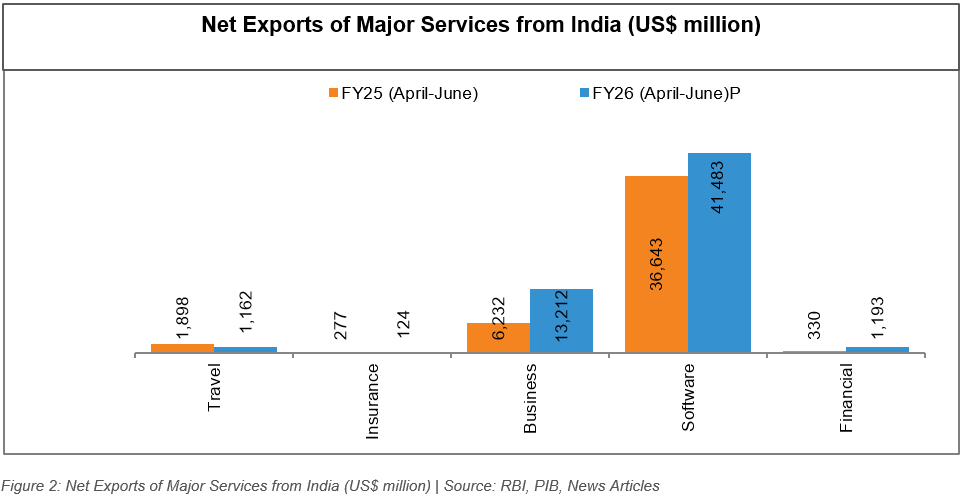
- India's services exports reached US$ 418.31 billion in 2025-26, up from US$ 387.55 billion in 2024-25, growth of around 7.94%; services exports accounted for around 10% of GDP in H1 2025-26.
- Services exports during April-July 2026-27 rose 6.38% to US$ 142.64 billion, while the services trade surplus for the period stood at US$ 69.17 billion, up from US$ 64.35 billion in April-July 2025-26.
- India's technology sector is projected to surpass US$ 315 billion in 2025-26, with exports expected to exceed US$ 246 billion, up 5.60% year-on-year (YoY).
- India climbed to the 38th position out of 133 economies in the Global Innovation Index (GII) 2025, according to the World Intellectual Property Organization (WIPO).
KEY SEGMENTS
INVESTMENTS AND FDI
- The services sector attracted cumulative FDI equity inflows of US$ 128.85 billion between April 2000 and March 2026, remaining the largest FDI-recipient sector in India.
- The computer software and hardware sector separately drew Rs. 9,07,251 crore (US$ 124.64 billion) in FDI over the same period, led by Singapore, Mauritius and the US as top investors.
- India is poised to attract over Rs. 52,32,600 crore (US$ 610 billion) in alternative investments, primarily private equity and venture capital, between 2025 and 2027.
- Data centre capacity has quadrupled from about 375 MW in 2020 to around 1.50 GW in 2025, with power demand projected to reach 13.56 GW by 2031-32, driven by rising AI and cloud computing demand.
- Liberalised FDI norms across financial services, aviation, education and healthcare continue to draw sustained foreign investor interest.
GOVERNMENT INITIATIVES
- Action Plan for Champion Sectors in Services: Targets 12 key sectors including IT-ITeS, tourism, medical value travel and finance, with Rs. 5,000 crore (US$ 608 million) allocated for sectoral initiatives.
- Goods and Services Tax (GST) 2.0: Rationalised rates across services, moving several categories to 18% while reducing tailoring, beauty and cleaning services to 5%, and exempting health and life insurance.
- 100% FDI Policy: Permitted under the automatic route for regulated financial services, aviation, and education, with liberalised norms for greenfield healthcare projects.
- National Education Policy (NEP) 2020: Implementation continues with a target Gross Enrolment Ratio of 50% by 2035, alongside skill-based learning and digital integration.
- BharatNet Project: Allocation increased 264% YoY to Rs. 20,000 crore (US$ 2.26 billion) in 2026-27 to expand rural broadband connectivity.
- Atal Tinkering Labs (ATL): An allocation of Rs. 3,200 crore (US$ 362 million) in 2026-27 to establish innovation labs promoting STEM, AI and robotics education.
- Regional Medical Hubs Scheme: Five hubs to be established under public-private partnerships to strengthen India's position as a global medical tourism destination.
- PRAVAAH Platform: An RBI single-window system with over 108 standardised forms for faster, more transparent regulatory approvals.
DRIVERS AND OPPORTUNITIES
- Rising digital adoption - The Unified Payments Interface (UPI) accounts for nearly 50% of global real-time payment transaction volume, processing 2,365.84 crore transactions in July 2026 alone.
- GCC ecosystem expansion - India is projected to host over 2,500 Global Capability Centres by 2030, employing up to 2.90 million professionals, with Tier-II cities offering 25-50% cost savings over Tier-I hubs.
- Growing fintech adoption - India's fintech adoption rate stands at 87%, well above the global average of 67%.
- Expanding trade agreements - Nine Free Trade Agreements, including the India-EU FTA concluded in January 2026, are opening new market access for Indian service providers.
- Robust export momentum - India's exports of goods and services grew nearly 15% during April-July 2026, supporting the government's target of US$ 1 trillion in exports in 2026-27.
- Deep digital talent pool - India accounts for nearly 75% of the global digital talent pool, anchoring its position as a global outsourcing and innovation hub.
STRATEGIES
- CSR-led financial inclusion - HDFC Bank's Parivartan initiative is deploying mobile medical care units and skilling centres across underserved regions to strengthen the workforce for India's growing services sector.
- AI partnership ecosystem - Tata Consultancy Services (TCS) has expanded its AI capabilities through partnerships with Google Cloud, GitLab, ServiceNow and Honeywell, alongside its Gemini Experience Centres.
- Enterprise digital transformation - Bharti Airtel is strengthening enterprise offerings across connectivity, data centres and cybersecurity through strategic partnerships and expanding 5G infrastructure.
M&A
- In February 2026, Tata Consultancy Services partnered with GitLab Inc. to accelerate enterprise software development through AI-led orchestration and automation.
- On August 10, 2026, Airtel Business and ITI Limited entered a strategic partnership to help enterprises accelerate digital transformation across connectivity, data centres and cybersecurity.
- In February 2026, the Digital India BHASHINI Division and the Reserve Bank of India signed a Memorandum of Understanding (MoU) to integrate AI-powered language technologies into banking services across 22 scheduled languages.
TRENDS
- AI-driven enterprise transformation - Companies across IT, banking and telecom are rapidly adopting agentic AI, with TCS alone operating three Gemini Experience Centres in India.
- Digital health expansion - The Ayushman Bharat Digital Mission has digitally linked over 110 crore health records, with women holding 49.72% of ABHA accounts.
- GCCs moving to Tier-II cities - Cities beyond Bengaluru and Hyderabad are emerging as GCC hubs, offering lower costs while retaining access to quality talent pools.
- Real-time payments going global - UPI is now accepted in 11 countries, including Singapore, the UAE, France and Mauritius, extending India's digital payments leadership abroad.
RECENT DEVELOPMENTS
- August 2026 : Airtel Business and ITI Limited entered a strategic partnership to accelerate enterprise digital transformation.
- July 2026 : Tata Consultancy Services launched its Consumer Business Group Gemini Experience Centre in Kolkata, developed with Google Cloud and Google's Gemini models.
- June 2026 : Gujarat approved the establishment of India's first dedicated Service Commissionerate, alongside a Rs. 100 crore (US$ 10.56 million) Service Sector Growth Fund.
- March 2026 : HDFC Bank launched the Parivartan Skilling Centre in Bareilly, Uttar Pradesh, targeting 850 youth for Banking, Financial Services and Insurance (BFSI) and retail sector employment.
- February 2026 : The India-EU Free Trade Agreement was concluded, providing preferential access across 97% of EU tariff lines and extending commitments across 144 services subsectors.
- November 2025 : Tata Consultancy Services partnered with TPG to invest up to Rs. 18,000 crore in its AI data centre platform, HyperVault.

FAQs
It comprises trade and repair services, transport and communication, financial services, real estate and professional services, and public administration, spanning sub-sectors such as IT-ITeS, banking, telecom, healthcare and tourism.
It contributes 56.4% of India's GVA, generates the highest share of employment, and remains the country's largest recipient of FDI.
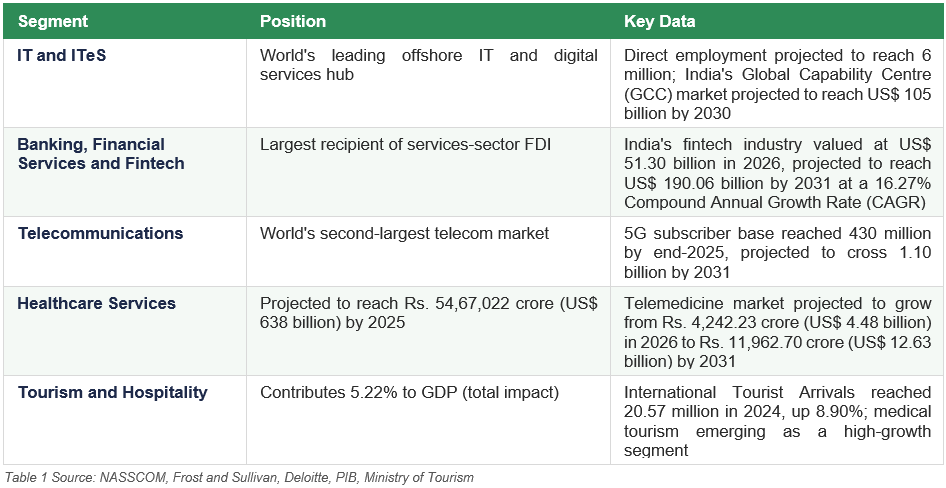
The major segments are IT and ITeS, banking and financial services, telecommunications, healthcare services, and tourism and hospitality.
Key drivers include rising digital adoption, GCC ecosystem expansion, growing fintech adoption, expanding trade agreements, and a deep digital talent pool.
India's technology sector is projected to surpass US$ 315 billion in FY26, with exports exceeding US$ 246 billion and direct employment reaching 6 million.
Support includes the Action Plan for Champion Sectors in Services, GST 2.0, the BharatNet project, and liberalised FDI norms across financial services, aviation and education.
Opportunities include Global Capability Centres, fintech and digital banking, healthcare and telemedicine, and an estimated US$ 610 billion in alternative investments through 2027.
Digital transformation is evident through UPI's global expansion, AI adoption across banking and IT, the Ayushman Bharat Digital Mission, and rapid 5G rollout.
The services sector is expected to contribute 60% of India's GDP by 2047, with India targeting a 10% global share of services exports by the same year.
Related News
MORE
IBEF Campaigns
MORE

Case Studies
MOREHow Indian Pharmaceutical Companies Are Strengthening Their Position in Global Markets

India has become a key player in the pharmaceutical industry of the world, which can be described in terms of the following factors: large-scale manuf...
Containerisation: Transforming India's Maritime Trade

Despite other modes of transportation, the maritime shipping mode is the backbone of international trade. The concept of containerisation has revoluti...
India’s Growing Senior Care Needs: New Businesses and Services
The current state of India is characterised by the process of demographic transition with gradual growth of the proportion of senior citizens within t...
IBEF BLOG
MORE
Semiconductor Equipment and Materials: Strengthening India's Position in the Global Chip Supply Chain
The semiconductor manufacturing strategy in India is getting more comprehen...
India's Deep-Tech Startup Wave: Beyond Fintech and E-commerce
The Indian start-up eco-system, traditionally known for its focus on digita...

Investment Opportunities in India: Sectors With Strong Growth Potential
India has emerged as a potential investment destination owing to its econom...
Partners