EXECUTIVE SUMMARY
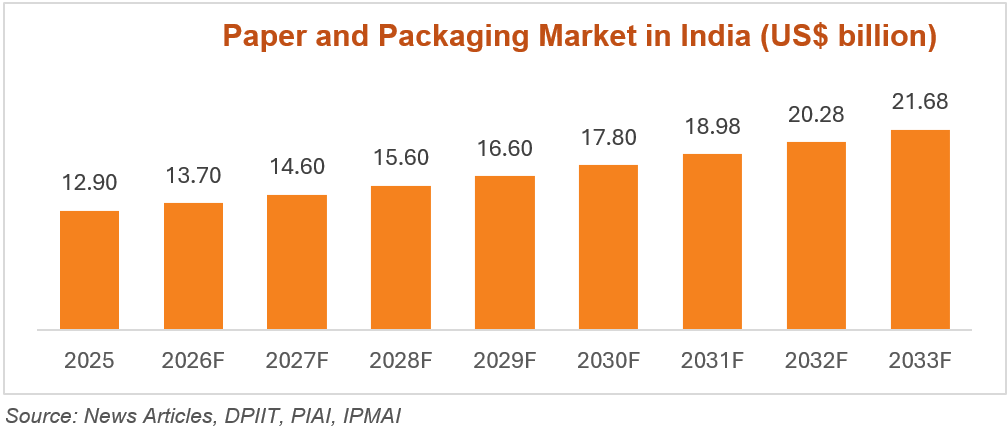
India's paper and packaging market was valued at US$ 12.90 billion in 2025 and is projected to reach US$ 21.68 billion by 2033. India produces around 5% of global paper, ranking 15th worldwide, with 850 paper mills producing about 25 million tonnes annually, expected to rise to around 35 million tonnes by FY30.

Market Size (2025)
US$ 12.90 billion

Projected Market Size (2033)
US$ 21.68 billion

Paper Production (2024)
25 million tonnes

Global Paper Ranking
15th
INTRODUCTION
India's paper and packaging industry spans paper and paperboard manufacturing, pulp production, and flexible and rigid packaging, serving end-users from food processing and pharmaceuticals to e-commerce and consumer goods. The sector evolved through distinct phases: significant growth before the 1990s as economic reforms took hold; capacity expansion by companies such as ITC, JK Paper and West Coast Paper Mills between 1990 and 2005; substantial investment and export growth between 2005 and 2010; and deepening sustainability focus and government support from 2010 onwards. India's broader packaging industry has emerged as the world's third-largest, exceeding Rs. 7,36,246 crore (US$ 86 billion) as of September 2024 and ranking as the fifth-largest sector of the Indian economy, expanding at 22-25% annually. The industry is highly entrepreneurial, with over 22,000 packaging units, of which 85% are Small and Medium Enterprises (SMEs). A notable feature of India's paper industry is its reliance on sustainable raw materials, with around 74-76% of production in 2024-25 sourced from recovered paper and recycled fibre, 18-20% from wood and bamboo, and 6-8% from agro residues such as bagasse and wheat straw.
Rising urbanisation, e-commerce expansion and demand from food processing and Fast-Moving Consumer Goods (FMCG) sectors are driving sustained growth, supported by Government initiatives, liberal Foreign Direct Investment (FDI) norms and innovations in smart and sustainable packaging.
MARKET SIZE AND GROWTH
- India's paper and packaging market was valued at US$ 12.90 billion in 2025 and is projected to grow steadily to US$ 21.68 billion by 2033.
- India's paper packaging market reached Rs. 1,67,110 crore (US$ 19.07 billion) as of August 2025 and is projected to grow at a CAGR of 19.48% to reach Rs. 4,06,866 crore (US$ 46.43 billion) by 2030.
- In 2025-26, India Paper Manufacturers Association (IPMA) member mills reported production of 5,208 thousand tonnes against an installed capacity of 5,368 thousand tonnes, a capacity utilisation of 97.01%.
- India is home to around 850 paper mills producing about 25 million tonnes of paper annually, a figure expected to rise to approximately 35 million tonnes by FY30.
- India's food and beverage packaging market is projected to grow from Rs. 3,31,595 crore (US$ 38.30 billion) in 2025 to Rs. 4,53,625 crore (US$ 52.50 billion) in 2030, a CAGR of around 6.50%.
- According to Brickwork Ratings, India's paper demand is expected to reach nearly 30 million tonnes by 2027, driven by packaging, e-commerce, FMCG and education.
KEY SEGMENTS
The packaging industry is broadly categorised into flexible and rigid formats, with flexible packaging leading India's packaging market.
- Flexible packaging held 54.32% of India's packaging market in 2024, growing at an 11.51% CAGR, as converters switched from rigid tubs to lightweight pouches, while rigid packaging remained strong in carbonated beverages, detergents and premium skincare.
- India's flexible packaging market is expected to expand by Rs. 1,35,642 crore (US$ 15.60 billion) during 2024-28, growing at a CAGR of 12.70%, driven by strong demand from the FMCG sector.
- Domestic sales of paper and paperboard accounted for 4.41 million tonnes in 2024-25, while exports stood at 0.49 million tonnes.
- India's flexible packaging market grew by US$ 12.72 billion at a CAGR of almost 11% during 2021-25, according to the Confederation of Indian Industry (CII), with film manufacturing capacity rising 45% over the past four years.
INVESTMENTS AND FDI
- Cumulative FDI inflows in the Paper and Pulp (including paper) sector stood at Rs. 10,783.60 crore (US$ 1,813.89 million) between April 2000 and March 2026, with 100% FDI permitted through the automatic route.
- In December 2024, JK Paper Limited approved the acquisition of a 60% stake in Radhesham Wellpack Private Limited, with plans to acquire the remaining 40% over two years to strengthen its packaging business.
- In November 2025, UFlex Limited announced an investment of over Rs. 700 crore (US$ 80.20 million) to expand its packaging film manufacturing facility in Dharwad, Karnataka, adding 54,000 Metric Tonnes Per Annum (MTPA) of new capacity.
- In December 2025, SIG commenced full operations at its first aseptic carton manufacturing plant in Ahmedabad, Gujarat, with an investment of US$ 90 million and capacity for four billion packs annually.
- In January 2025, JK Paper Limited approved the acquisition of a 65% majority stake in Quadragen VetHealth Private Limited for Rs. 769.23 crore, expanding into the animal nutrition sector.
GOVERNMENT INITIATIVES
- GST reduction: Goods and Services Tax (GST) on packing paper, cartons, corrugated boxes and moulded pulp trays has been reduced to 5%, lowering packaging and logistics costs for e-commerce shipments.
- FSSAI packaging regulations: On August 10, 2026, the Food Safety and Standards Authority of India (FSSAI) notified new regulations for pan masala packaging, banning plastic, aluminium foil and metallised layers while permitting plastic-free paper, paperboard, cellulose, tin and glass.
- Export promotion mission: On July 14, 2026, the Government issued guidelines under a Rs. 25,060 crore export promotion mission to support branding, packaging strategies and international-standard design solutions.
- Extended Producer Responsibility (EPR) Rules 2024: Notified by the Ministry of Environment, Forest and Climate Change (MoEF&CC), these mandate paper packaging producers to meet phased recycling targets from April 2026.
- Union Budget 2026-27: The Government allocated Rs. 12.20 lakh crore (US$ 139.75 billion) towards capital expenditure, reinforcing infrastructure-led growth and supporting demand for packaging materials.
DRIVERS AND OPPORTUNITIES
- E-commerce and food processing growth - India's food processing sector is projected to more than double from Rs. 26,41,121 crore (US$ 307 billion) in 2023 to Rs. 60,22,100 crore (US$ 700 billion) by 2030, while domestic packaged-food sales are expected to reach Rs. 11,02,610 crore (US$ 116 billion) by 2027.
- Rising per capita consumption - India's per capita paper consumption stands at 16 kg, compared with the global average of 57 kg, indicating significant headroom for growth as literacy and retail expand.
- Sustainability shift - India's green packaging market is projected to grow at a CAGR of 7.24% during 2023-28, supported by rising demand for biodegradable and recyclable paper-based packaging.
- E-commerce expansion - E-commerce packaging grew at a CAGR of 15.10% in 2024, with returns-ready, paper-based designs gaining traction, while the Indian e-commerce industry is expected to reach US$ 350 billion by 2030.
- Food services growth - India's food services sector, valued at Rs. 5,69,000 crore (US$ 65.76 billion) in CY24, is projected to grow at a CAGR of 8.10% to reach Rs. 7,76,000 crore (US$ 89.65 billion) by CY28.
STRATEGIES
- Sustainable practices - Companies are adopting sustainable forestry practices and eco-friendly production processes, with AUM Premium announcing plans on July 24, 2026 to launch paper-based water bottles to reduce plastic dependence.
- Product diversification - Companies such as UFlex Limited offer diverse flexible packaging solutions, including laminates, tubes and labels, catering to food, pharmaceuticals and personal care industries.
- Cost optimisation - On June 5, 2026, McKinsey highlighted Artificial Intelligence (AI)-led "site sprints" as a cost-optimisation approach integrating fibre, energy, procurement and operations, capable of reducing costs by up to 20%.
- Digital transformation - In April 2026, Surya Global Flexifilms partnered with SAP and SAVIC to implement SAP S/4HANA RISE, accelerating its transition towards a digitally integrated, intelligent manufacturing ecosystem.
- Customer-centric innovation - Companies are offering value-added services such as design assistance and customised packaging solutions, alongside quality certifications such as the Forest Stewardship Council (FSC) standard.
- Exhibitions and industry collaboration - PAPEXPO 2025, India's first dedicated paper industry exhibition, was held in June 2025 at HITEX Hyderabad, bringing together over 100 exhibitors and 15,000-plus visitors.
M&A
- In July 2025, JK Paper Limited's board approved the acquisition of a 72% stake in Borkar Packaging Private Limited, with the balance to be acquired within four years.
- In March 2025, ITC acquired the Pulp and Paper Undertaking of Aditya Birla Real Estate Limited.
- In March 2025, Hindustan Unilever Limited (HUL) acquired Lucro Plastecycle Private Limited.
- In January 2025, PAG, an alternative asset manager, acquired Pravesha Industries Private Limited.
TRENDS
- Circular economy focus - Paper is recyclable seven to ten times, and India's paper, print and packaging sectors are increasingly emphasising recovered fibre and resource efficiency as a key circular-economy pillar.
- Rising containerboard costs - McKinsey noted that price spikes in recycled containerboard are driving cost pressures across India's paper and packaging sector, even as AI and operational excellence offer efficiency gains.
- Smart packaging adoption - Technologies including RFID, NFC and QR codes are increasingly used to enhance product authentication and supply chain efficiency across the packaging value chain.
- Sustainable food delivery - Zomato's Plastic-Free Future Program now covers 10,000 restaurants across 490-plus cities, facilitating 80 million sustainable orders and recycling around 45,000 Metric Tonnes (MT) of plastic waste since FY23.
- Trade growth - During FY26, India's paper, paperboard and newsprint imports reached 2,552.80 thousand tonnes, while exports stood at 1,536.50 thousand tonnes, reflecting deepening global integration.
RECENT DEVELOPMENTS
- August 2026 : TCPL Packaging announced a Rs. 125 crore (US$ 13.06 million) investment over 18 months to enter lithium-ion battery separator film manufacturing.
- July 2026 : AUM Premium announced plans to launch paper-based water bottles using responsibly sourced paper and a recycling partnership with Scrapbuddy.
- March 2026 : EPL Limited announced its merger with Indovida, creating a diversified packaging platform valued at approximately Rs. 18,400 crore (US$ 2 billion).
- February 2026 : UFlex Limited introduced F-HSS, a high-seal-strength biaxially oriented transparent polyester film, at PLASTINDIA 2026.
- February 2026 : Amazon India and IIT Roorkee partnered to develop strong, recyclable and home-compostable paper packaging from crop waste.
- January 2026 : The Union Cabinet approved a Rs. 1,788 crore (US$ 204.80 million) project to establish a new banknote paper production line in Narmadapuram.
FAQs
India's paper and packaging market is estimated to reach US$ 21.68 billion by 2033, growing steadily from US$ 12.90 billion in 2025.
Key drivers include e-commerce expansion, food processing growth, rising per capita consumption, sustainability-led demand for paper-based packaging, and supportive government policy.
Sustainability is central to the sector, with 74-76% of paper production sourced from recovered paper and recycled fibre, and the green packaging market projected to grow at a 7.24% CAGR through 2028.
Flexible packaging leads India's packaging market with a 54.32% share, while food and beverage packaging and e-commerce-driven packaging are among the fastest-growing segments.
Support includes GST reduction to 5% on packing paper and cartons, FSSAI's sustainable packaging regulations, EPR Rules 2024, and a Rs. 25,060 crore export promotion mission.
Innovations include AI-led cost optimisation, smart packaging technologies such as RFID and QR codes, digital manufacturing platforms, and bio-based, plastic-free packaging materials.
The industry is expected to sustain strong growth, driven by rising demand for sustainable packaging, e-commerce expansion, government support and India's position as the world's third-largest packaging market.
Related News
MOREIBEF Campaigns
MORE

Case Studies
MOREHow Indian Pharmaceutical Companies Are Strengthening Their Position in Global Markets

India has become a key player in the pharmaceutical industry of the world, which can be described in terms of the following factors: large-scale manuf...
Containerisation: Transforming India's Maritime Trade

Despite other modes of transportation, the maritime shipping mode is the backbone of international trade. The concept of containerisation has revoluti...
India’s Growing Senior Care Needs: New Businesses and Services

The current state of India is characterised by the process of demographic transition with gradual growth of the proportion of senior citizens within t...
IBEF BLOG
MORE
Semiconductor Equipment and Materials: Strengthening India's Position in the Global Chip Supply Chain
The semiconductor manufacturing strategy in India is getting more comprehen...

India's Deep-Tech Startup Wave: Beyond Fintech and E-commerce
The Indian start-up eco-system, traditionally known for its focus on digita...
Investment Opportunities in India: Sectors With Strong Growth Potential
India has emerged as a potential investment destination owing to its econom...
Partners