EXECUTIVE SUMMARY
In the Union Budget 2026-27, India's capital investment outlay for infrastructure was increased to Rs. 12.22 lakh crore (US$ 138.30 billion), an 11.50% rise over the revised estimate for 2025-26. India's National Highways network expanded to 1,46,560 km in FY26, while installed power generation capacity reached 548.85 Gigawatts (GW) as of June 30, 2026.

Capital Investment Outlay (FY27)
US$ 138.30 Billion

National Highways Network (FY26)
1,46,560 km

Employment (FY24)
548.85 GW

Logistics Market (2025)
US$ 240.50 Billion
Introduction
India's infrastructure sector spans roads and highways, railways and metro rail, ports and shipping, airports, power and energy, urban development and housing, telecommunications, and logistics and warehousing. Any investment in the construction sector alone impacts 275 linked building materials, component and machinery industries, with the sector accounting for around 8.20% of the economy.
India now has the world's second-largest road network and the third-largest metro rail network, with over 1,143 km of operational metro lines across 29 cities. The sector has evolved through sustained policy reform, from the Eleventh Plan (2007-12), when private investment contributed about 37% of total infrastructure spending, to today's National Infrastructure Pipeline (NIP), which spans 33 sectors and has grown from around 6,800 projects at inception to approximately 14,563 projects, with total investment rising nearly 92% to Rs. 213 trillion (US$ 2.41 trillion).
By 2036, the World Bank projects that 600 million people, around 40% of India's population, will live in cities, intensifying demand for clean water, reliable power and efficient transport. With record government capital expenditure, growing private participation through Public-Private Partnerships (PPPs), and continued reforms, India's infrastructure sector is central to the country's ambition of becoming a US$ 5 trillion economy while building world-class, sustainable infrastructure.
MARKET SIZE AND GROWTH
- In the Union Budget 2026-27, capital investment outlay for infrastructure was increased to Rs. 12.22 lakh crore (US$ 138.30 billion), an 11.50% rise over the revised estimate for 2025-26.
- According to CRISIL's Infrastructure Yearbook 2023, India will spend nearly Rs. 143 lakh crore (US$ 1,727.05 billion) on infrastructure over seven fiscals through 2030, more than double the nearly Rs. 67 lakh crore (US$ 912.81 billion) spent in the previous seven years.
- India's government capital expenditure has risen more than fourfold, from Rs. 2.63 lakh crore (US$ 40.81 billion) in FY18 to Rs. 11.21 lakh crore (US$ 126.85 billion) in FY26 (BE).
- The combined Index of Eight Core Industries (ICI) stood at 119.60 in June 2026, compared with 120.10 in May 2026, with cement (+9.77%) and electricity (+9.85%) recording the strongest year-on-year (YoY) growth.
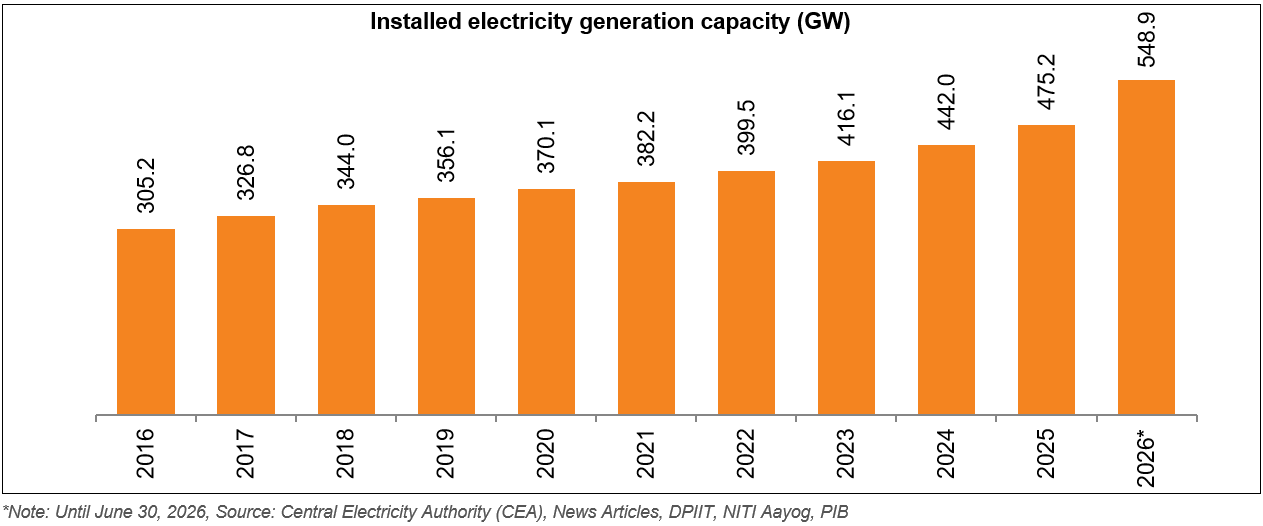
- India's installed electricity generation capacity grew at a Compound Annual Growth Rate (CAGR) of 6.05% between 2016 and 2026, reaching 548.85 GW as of June 30, 2026.
KEY SEGMENTS
Roads, railways, power and logistics together form the backbone of India's infrastructure sector.
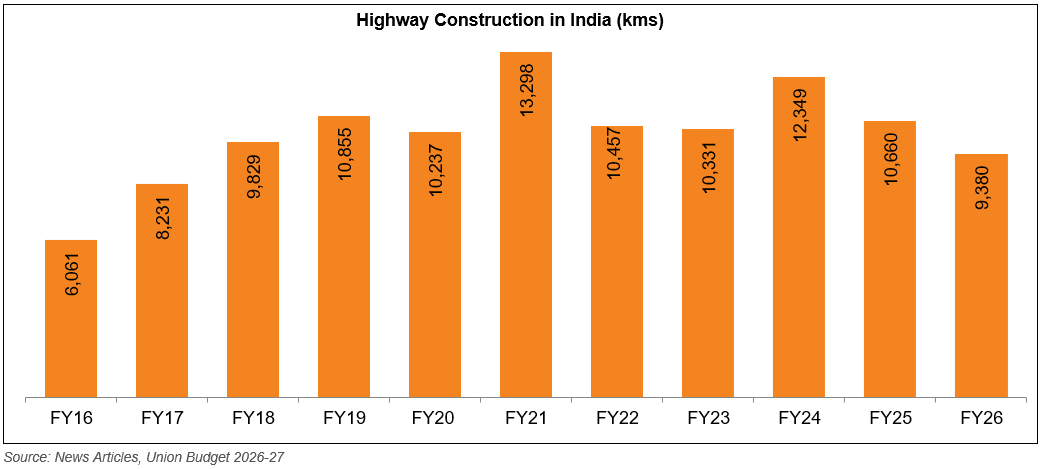
- India's National Highways network expanded from 91,287 km in 2014 to its current size, with 57,125 km built over the last five years and 9,380 km constructed in FY26 alone.
- Indian Railways' gross revenue reached Rs. 2.79 lakh crore (US$ 31.57 billion) in FY26, with freight loading rising 5.27% to 1,700 Million Tonnes (MT) and passenger traffic reaching a new high of 7.38 billion.
- India's total installed electricity capacity reached 548.85 GW as of June 30, 2026, with non-fossil sources accounting for about 54% of the total.
- India's logistics market, valued at US$ 240.50 billion in 2025, is projected to reach US$ 527.50 billion by 2033, a CAGR of 10.90%.
INVESTMENTS AND FDI
- Cumulative Foreign Direct Investment (FDI) inflows stood at Rs. 1,39,474.23 crore (US$ 27.55 billion) in construction development and Rs. 2,81,161.95 crore (US$ 38.74 billion) in construction (infrastructure) activities between April 2000 and March 2026.
- Total FDI inflows in the power sector reached Rs. 1,24,372.37 crore (US$ 20.10 billion) between April 2000 and March 2026, accounting for 2.55% of India's total FDI inflows.
- The Second Asset Monetization Plan aims to recycle Rs. 10 lakh crore (US$ 115.34 billion) in capital into new infrastructure projects between 2025-30.
GOVERNMENT INITIATIVES
- PM GatiShakti National Master Plan: Has integrated 44 Central Ministries and 36 States and Union Territories (UTs), assessing 208 major projects worth Rs. 15,39,000 crore (US$ 178.89 billion) and identifying 52 critical projects connecting maritime ports and inland waterway terminals.
- Bharatmala Pariyojana: A network of 35 Multimodal Logistics Parks is planned under this programme, with a total investment of about Rs. 46,000 crore (US$ 5.50 billion), capable of handling around 700 million metric tonnes of cargo once operational.
- Smart Cities Mission: As of June 24, 2025, 94% of 8,067 projects had been completed, involving investments of Rs. 1,64,000 crore (US$ 19.14 billion), with 99.44% of the Rs. 47,652 crore (US$ 5.56 billion) budget released to 100 cities.
- Infrastructure Finance Secretariat: Established to enhance private sector participation and facilitate investment opportunities across key infrastructure sectors.
- 50-year interest-free loan scheme: Union Budget 2026-27 continued this scheme for states' capital expenditure, with an enhanced outlay of Rs. 1.85 lakh crore (US$ 20.10 billion), up from a revised estimate of Rs. 1.44 lakh crore (US$ 16.20 billion) in 2025-26.
DRIVERS AND OPPORTUNITIES
- Rapid urbanisation - The World Bank projects that 600 million people, nearly 40% of India's population, will live in cities by 2036, driving demand for housing, clean water, power and transport infrastructure.
- Public-Private Partnerships - PPPs contributed about 37% of total infrastructure spending during the Eleventh Plan (2007-12), and nearly 60% of national highways developed between 2009 and 2013 were built under PPP models.
- Logistics and warehousing growth - India's warehousing market is projected to grow to around US$ 27 billion by 2026, a CAGR of 10.90%, while the express logistics and courier sector is projected to grow from Rs. 78,525 crore (US$ 9 billion) in FY25 to Rs. 1,57,050-1,91,950 crore (US$ 18-22 billion) by FY30.
- Housing demand - GST 2.0 is expected to reduce construction costs by 3.50-4.50%, lowering housing prices by 5-8% and boosting demand in the affordable and mid-segment markets.
- Airport expansion - The Union Budget 2025-26 announced plans to connect 120 new airports over the next decade, targeting four crore additional passengers, with India's "Vision 2040" targeting 190-200 functioning airports.
STRATEGIES
- Green data centre and hydrogen investment - On January 21, 2026, Larsen & Toubro's digital infrastructure arm, L&T Vyoma, commenced development of a 40 MW green, AI-ready data centre at Navi Mumbai, part of a planned 100 MW campus, while L&T Energy GreenTech announced India's largest green hydrogen plant at IOCL Panipat Refinery.
- Sustainability initiatives - Bharat Heavy Electricals Limited (BHEL) launched Harit BHEL, a green initiative focused on renewable energy and sustainability, and signed a Memorandum of Understanding (MoU) with Singapore's Horizon Fuel Cell Technologies for hydrogen-powered trains in September 2025.
- Digital passenger experience - GMR Innovex is developing digital solutions to enhance airport passenger experience, while GMR Aero Academy and GMR School of Aviation are building a skilled aviation workforce.
- Global expansion - Adani Ports and SEZ is targeting expansion into the Philippines, Vietnam and Indonesia, aiming for 140-150 Million Metric Tonnes (MMT) of international throughput by 2030.
M&A
- Adani Ports and SEZ refinanced Rs. 9,034 crore (US$ 1.05 billion) of debt and invested Rs. 12,000 crore (US$ 1.40 billion) in 2025 to support its international expansion.
- As of October 14, 2025, London-based infrastructure investor Actis said India is one of the most attractive infrastructure markets globally and plans to explore doubling its existing Rs. 17,500 crore (US$ 2 billion) investment across India's energy, roads, transportation and digital infrastructure.
- In February 2024, NTPC and the National Aluminium Company (NALCO) signed an MoU to explore providing 1,200 MW of continuous power for NALCO's Odisha smelter expansion.
- External Affairs Minister Mr. S. Jaishankar announced an investment target of Rs. 3,59,898 crore (US$ 42 billion) between India and Japan by 2027.
TRENDS
- Railway electrification - of March 2026, Indian Railways had electrified 99.60% of its broad-gauge network under its "Mission 100% Electrification" initiative, reducing traction fuel consumption by approximately 136 crore litres between 2018-19 and 2023-24.
- Metro rail expansion - India's metro network continues to expand rapidly, with a further 980 km under construction across 27 cities, reinforcing its position as the world's third-largest metro network.
- Clean energy transition - Non-fossil fuel sources accounted for about 54% of India's total installed power capacity as of June 30, 2026, reflecting continued expansion in clean power generation.
- Rising private investment - Financing through Non-Banking Financial Companies (NBFCs) and Infrastructure Investment Trusts (InvITs)/Real Estate Investment Trusts (REITs) is expanding, widening the funding base for large-scale infrastructure projects.
- Northeast connectivity push - As of July 2025, 16,207 km of National Highways had been constructed in the Northeast Region, alongside 16,469 Pradhan Mantri Gram Sadak Yojana (PMGSY) road works covering 80,933 km.
RECENT DEVELOPMENTS
- July 2026 : GMR Airports announced a multi-phase modernisation and expansion plan for Dr. Babasaheb Ambedkar International Airport, Nagpur.
- February 2026 : The Union Cabinet approved Rs. 12,236 crore (US$ 1.38 billion) worth of projects across metro rail, airports and railways, including a Rs. 1,067 crore (US$ 120.74 million) Ahmedabad Metro extension.
- January 2026 : Larsen & Toubro's L&T Vyoma commenced development of a 40 MW green, AI-ready data centre at Navi Mumbai, part of a planned 100 MW campus.
- January 2026 : Reliance Industries announced a Rs. 7 lakh crore (US$ 75.56 billion) investment in Gujarat to expand clean energy, AI-ready data centres and solar infrastructure.
- November 2025 : The Union Cabinet approved Phase II of the Pune Metro Rail Project, worth Rs. 9,857 crore (US$ 1.13 billion), to build 31.64 km of new corridors with 28 elevated stations.
- May 2025 : Prime Minister Narendra Modi inaugurated the Vizhinjam International Seaport in Kerala, India's first transshipment hub, developed at a cost of Rs. 8,867 crore (US$ 1.03 billion).

FAQs
The infrastructure sector in India comprises roads, railways, airports, ports, power, urban infrastructure, logistics, bridges, and digital infrastructure. It is a key driver of economic growth, improving connectivity, industrial development, and overall competitiveness.
The infrastructure industry supports economic growth by improving transportation, logistics, energy access, urban development, and industrial productivity. Efficient infrastructure reduces business costs, strengthens supply chains, and enhances India's global competitiveness.
The infrastructure sector includes roads, railways, metro rail, airports, ports, power, renewable energy, logistics, urban infrastructure, housing, water supply, and digital infrastructure. Together, these segments support India's long-term economic and industrial development.
The infrastructure sector in India is expanding due to higher public capital expenditure, PM Gati Shakti, the National Infrastructure Pipeline (NIP), rapid urbanisation, logistics development, private investments, and increasing demand for multimodal connectivity.
The Government is strengthening the infrastructure industry through the National Infrastructure Pipeline (NIP), PM Gati Shakti, Bharatmala Pariyojana, Smart Cities Mission, PMGSY, and record capital expenditure to accelerate infrastructure development across the country.
The infrastructure sector in India offers investment opportunities across transport, logistics, renewable energy, urban infrastructure, airports, ports, industrial corridors, data centres, and digital infrastructure. Strong FDI inflows, PPP projects, and long-term government spending continue to attract investors.
The infrastructure sector continues to focus on faster project execution, land acquisition, financing, and sustainable infrastructure development. Greater private participation, digital project monitoring, and policy reforms are helping improve efficiency and long-term project delivery.
The Smart Cities Mission is strengthening the infrastructure sector in India through investments in intelligent mobility, digital governance, water management, public infrastructure, and sustainable urban development. More than 94% of Smart Cities projects have already been completed.
Private investment is accelerating the infrastructure industry through public-private partnerships (PPPs), FDI, green infrastructure, airports, logistics, renewable energy, and transportation projects. Government initiatives such as the proposed Infrastructure Risk Guarantee Fund are further strengthening investor confidence.
The infrastructure sector in India is expected to witness sustained growth, supported by higher capital expenditure, PM Gati Shakti, the National Infrastructure Pipeline, smart cities, logistics expansion, and increasing private investment, reinforcing India's long-term economic development.
Related News
MOREInfrastructure India

Posters
MORE
ROADS TO FUTURE
India has the third largest road network in the world spanning over 3.3 million km.
IBEF Campaigns
MORE

Case Studies
MOREHow Indian Pharmaceutical Companies Are Strengthening Their Position in Global Markets

India has become a key player in the pharmaceutical industry of the world, which can be described in terms of the following factors: large-scale manuf...
Containerisation: Transforming India's Maritime Trade
Despite other modes of transportation, the maritime shipping mode is the backbone of international trade. The concept of containerisation has revoluti...
India’s Growing Senior Care Needs: New Businesses and Services

The current state of India is characterised by the process of demographic transition with gradual growth of the proportion of senior citizens within t...
IBEF BLOG
MORE
Semiconductor Equipment and Materials: Strengthening India's Position in the Global Chip Supply Chain
The semiconductor manufacturing strategy in India is getting more comprehen...
India's Deep-Tech Startup Wave: Beyond Fintech and E-commerce
The Indian start-up eco-system, traditionally known for its focus on digita...
Investment Opportunities in India: Sectors With Strong Growth Potential
India has emerged as a potential investment destination owing to its econom...
Partners