EXECUTIVE SUMMARY
India's gems and jewellery market stood at Rs. 7,31,255 crore (US$ 85 billion) as of January 2026 and is projected to expand to Rs. 11,18,390 crore (US$ 130 billion) by 2030. The sector contributes about 7% to India's Gross Domestic Product (GDP) and employs over 50 lakh people, with exports reaching US$ 27.72 billion in FY26.

Market Size (January 2026)
US$ 85B

Projected Market Size (2030)
US$ 130B

Exports (FY26)
US$ 27.72B

Contribution to GDP
7%
Introduction
India's gems and jewellery industry is one of the largest in the world, spanning the cutting and polishing of diamonds, and the manufacture, retail and export of gold, diamond, silver and coloured-gemstone jewellery. Its product range extends from cut and polished diamonds, studded and plain gold jewellery, and silver articles to lab-grown diamonds, coloured gemstones, platinum jewellery, and gold medallions and coins. The sector supports more than 300,000 players, ranging from large-organised retailers to small and micro enterprises, and employs over 50 lakh people in skilled and semi-skilled roles across manufacturing, design and retail.
India is also the world's second-largest consumer of gold jewellery, with gold demand projected to remain in the range of 600-700 tonnes in 2026, as rising investment demand offsets weaker jewellery consumption amid elevated gold prices.
Rising incomes, a growing affluent and middle-class consumer base, and continued appetite for both traditional and contemporary designs are expanding demand across urban and rural India alike. Exports remain central to the sector's identity, supported by Special Economic Zones (SEZs) dedicated to gems and jewellery manufacturing.
Cut and polished diamonds and gold jewellery together account for the vast majority of export value, while lab-grown diamonds are emerging as a fast-growing new category, backed by fresh investment from both established jewellers and venture-funded start-ups. Trade agreements with the United Kingdom (UK), the United Arab Emirates (UAE) and Australia are expected to further widen market access and strengthen India's position as a global sourcing and manufacturing hub for gems and jewellery.
MARKET SIZE AND GROWTH
- India's gems and jewellery market stood at Rs. 7,31,255 crore (US$ 85 billion) as of January 2026 and is projected to expand to Rs. 11,18,390 crore (US$ 130 billion) by 2030.
- The sector also contributes nearly Rs. 2.6 lakh crore (US$ 29.42 billion) to manufacturing output.
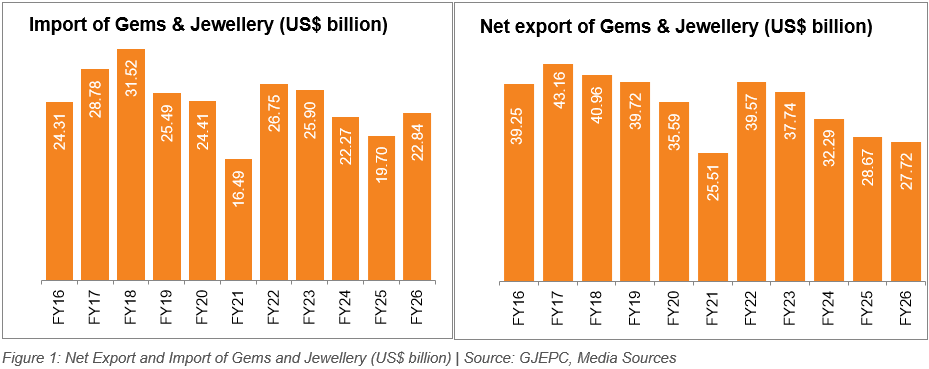
- India's gem and jewellery exports remained broadly stable in FY26 at Rs. 2,44,827.26 crore (US$ 27.72 billion), compared with Rs. 2,42,559.39 crore (US$ 28.67 billion) in FY25.
- The Government of India is targeting US$ 100 billion in jewellery exports over the next few years, up from US$ 35 billion in 2020.
- Overall gross imports stood at Rs. 2,02,120.40 crore (US$ 22.84 billion) in FY26.
KEY SEGMENTS
Cut and polished diamonds and gold jewellery together account for the vast majority of India's gems and jewellery exports, with lab-grown diamonds an emerging category.
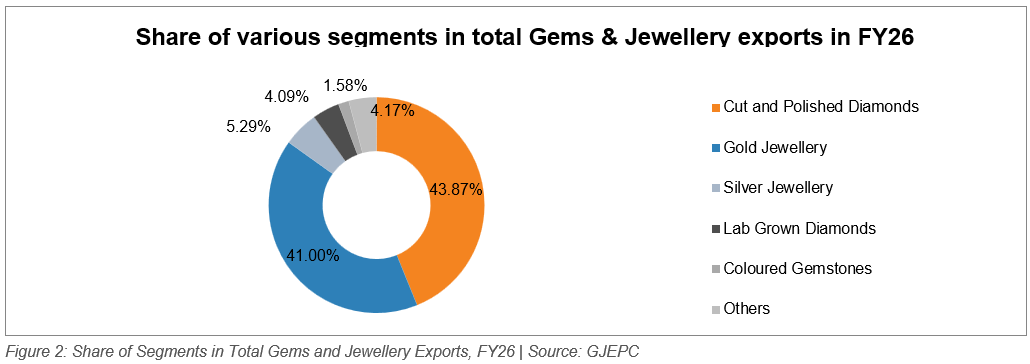
- In FY26, exports of cut and polished diamonds stood at Rs. 1,07,461.34 crore (US$ 12.16 billion), compared with Rs. 1,12,414.32 crore (US$ 13.29 billion) in FY25.
- Gold jewellery exports reached Rs. 1,00,277.64 crore (US$ 11.36 billion) in FY26, while imports fell sharply to Rs. 11,802.84 crore (US$ 1.32 billion) from Rs. 81,566 crore (US$ 9.56 billion) in FY25.
- India has ten dedicated SEZs for gems and jewellery hosting more than 500 manufacturing units, contributing around 30% of total exports.
INVESTMENTS AND FDI
- Cumulative Foreign Direct Investment (FDI) inflows in diamond and gold ornaments stood at Rs. 9,962.78 crore (US$ 1.55 billion) between April 2000 and March 2026, and India allows 100% FDI under the automatic route in the sector.
- In August 2026, Golkunda Diamonds & Jewellery announced a new manufacturing facility in Andheri, Mumbai, to strengthen its domestic presence and reduce reliance on Middle Eastern export markets.
- Between December 2025 and May 2026, the Reserve Bank of India's (RBI) gold reserves increased from Rs. 9,41,157.74 crore (US$ 111.30 billion) to Rs. 9,95,105.21 crore (US$ 112.60 billion), peaking at Rs. 11,63,018.17 crore (US$ 131.60 billion) in February 2026.
- Favourable FDI conditions and ease of doing business have attracted global luxury brands, with US jewellery brand Tiffany & Co inaugurating its first store in India.
GOVERNMENT INITIATIVES
- Goods and Services Tax (GST): The Government kept the GST rate for the jewellery sector unchanged at 3% in September 2025.
- FDI policy: 100% FDI is permitted under the automatic route, requiring no prior approval from the RBI or the Government of India.
- BIS Hallmarking Scheme: Gold jewellery carries a Bureau of Indian Standards (BIS) hallmark, including purity in carat and a unique Hallmark Unique Identification (HUID) number, ensuring authenticity and traceability.
- Gold Monetisation Scheme: Launched in November 2015, it enables individuals, trusts and mutual funds to deposit gold with banks and earn interest.
- India-UK Free Trade Agreement: Expected to more than double India's gems and jewellery exports to the UK to Rs. 21,183 crore (US$ 2.5 billion) within two to three years, by removing import duties of 2.5-4% on plain gold and diamond jewellery.
- India-UAE Comprehensive Economic Partnership Agreement (CEPA): India and the UAE reaffirmed plans to expand bilateral trade to US$ 200 billion by 2032, with gems and jewellery among the key sectors.
DRIVERS AND OPPORTUNITIES
- Rising gold investment demand - Gold Exchange-Traded Fund (ETF) inflows surged 574.9% month-on-month to Rs. 3,443.23 crore (US$ 389.6 million) in June 2026, while the AUM of Indian Gold ETFs grew from US$ 7.2 billion in April 2025 to US$ 18.4 billion by May 2026.
- Growing affluent consumer base - By 2036, India's middle class and affluent consumers are projected to account for 93% of all spending, up from 80% in 2026, while India held 3.7% of global High Net-worth Individuals (HNIs), with over 85,000 individuals worth above Rs. 85 crore (US$ 10 million), in 2025.
- Lab-grown diamonds - India's emerging lab-grown diamond segment is attracting fresh capital and new brands, from established players such as Titan's beYon to venture-backed start-ups such as Ethera and ONYA.
- Domestic gold supply - A proposed policy aims to raise the share of gold sourced from local refineries to 80% from around 40% currently, while proposed jewellery parks in Navi Mumbai and West Bengal could add manufacturing capacity.
- Trade agreements - Free trade agreements with the UK, the UAE and Australia, which will eliminate tariffs on 100% of Indian exports from January 1, 2026 under the India-Australia Economic Cooperation and Trade Agreement (ECTA), are expected to widen export markets.
STRATEGIES
- New category expansion - Retailers are expanding into new jewellery categories to attract urban consumers, with Titan entering coloured gemstones through Tanishq's 'Hues' collection and the lab-grown diamond segment through its beYon brand.
- Omnichannel and digital adoption - Jewellery retailers are re-evaluating brick-and-mortar models in favour of an omnichannel approach, with companies such as PC Jewellers, PNG Jewellers and Popley and Sons introducing virtual-reality experiences for customers.
- Customisation - Companies such as Malabar Gold have introduced customised jewellery that customers can alter to their own preferences.
- International expansion - Malabar Gold & Diamonds became the first Indian jewellery brand to open a store in Australia, while Mia by Tanishq expanded its overseas presence to three stores in the UAE.
- Trade and award shows - The International Gem & Jewellery Show (IGJS) Jaipur 2026, organised by the Gem and Jewellery Export Promotion Council (GJEPC), attracted over 230 international buyers from 30 countries, highlighting rising demand for customised jewellery, coloured gemstones and lab-grown diamonds.
M&A
- Titan Company is acquiring a 67% stake in Dubai-based Damas for Rs. 2,419 crore (US$ 283 million), giving it immediate access to 146 stores across six Gulf Cooperation Council (GCC) countries.
- Global institutions including Citigroup and Société Générale invested Rs. 170.60 crore (US$ 19.30 million) in PNGS Reva's Initial Public Offering (IPO) anchor round in February 2026.
- BlueStone invested Rs. 25 crore (US$ 2.83 million) in lab-grown diamond brand Ethera in February 2026.
- Zeropearl VC led a Rs. 5.50 crore (US$ 0.65 million) pre-seed round in lab-grown diamond retailer ONYA in December 2025.
TRENDS
- Lab-grown diamonds gaining share - Lab-grown diamonds accounted for 4.09% of India's gems and jewellery exports in FY26, and Limelight Diamonds is targeting over 100 stores in 2026 and 200-plus by 2027.
- Jewellery in space - In July 2026, Skyroot Aerospace, in collaboration with Cosmos Diamonds, launched the world's first lab-grown diamond jewellery into space aboard the Vikram-1 mission.
- Micro and small enterprises - Maximum recent development in the sector has been driven by micro and small enterprises (MSEs) in gems and jewellery and textiles.
- Franchise-led retail expansion - PC Jeweller announced plans to open up to 100 large franchise showrooms over 12-18 months to capture market share from the unorganised segment.
- Export moderation - India's gems and jewellery exports have declined nearly 29% from FY16 levels over the past decade, reflecting a period of consolidation even as the domestic market continues to expand.
Road Ahead
- August 2026 : GJEPC hosted the 42nd IIJS Premiere 2026 in Mumbai, featuring over 2,100 exhibitors, 3,000-plus stalls and buyers from more than 80 countries.
- July 2026 : PC Jeweller's board approved a Qualified Institutional Placement (QIP) to raise up to Rs. 1,000 crore (US$ 106 million) for business expansion and working capital.
- July 2026 : Skyroot Aerospace, in collaboration with Cosmos Diamonds, launched the world's first lab-grown diamond jewellery into space aboard the Vikram-1 mission.
- April 2026 : Titan launched the 'Hues' coloured gemstone jewellery collection under Tanishq, comprising over 200 designs.
- March 2026 : Mia by Tanishq opened its 275th exclusive store in Bengaluru, extending its presence to 75 cities in India and three stores in the UAE.
- January 2026 : Titan announced plans to strengthen its lab-grown diamond jewellery presence through its beYon brand.
FAQs
It is one of the world's largest gems and jewellery industries, spanning diamond cutting and polishing, and the manufacture, retail and export of gold, diamond and coloured-gemstone jewellery.
It contributes about 7% to India's GDP and nearly Rs. 2.6 lakh crore (US$ 29.42 billion) to manufacturing output, employing more than 50 lakh people.
The major segments are cut and polished diamonds, gold jewellery, silver jewellery, lab-grown diamonds and coloured gemstones, with cut and polished diamonds and gold jewellery together forming the largest share of exports.
Key drivers include rising gold investment demand, a growing middle class and affluent consumer base, the emerging lab-grown diamond segment, and new trade agreements with the UK, the UAE and Australia.
India is the world's second-largest consumer of gold jewellery and a major global hub for diamond cutting, polishing and jewellery manufacturing and export.
Support includes 100% FDI under the automatic route, the BIS Hallmarking Scheme, the Gold Monetisation Scheme, a stable 3% GST rate, and trade agreements with the UK, the UAE and Australia.
Opportunities span lab-grown diamond manufacturing, SEZ-based export manufacturing, and omnichannel and international retail expansion, backed by liberal FDI norms.
Exports of cut and polished diamonds and gold jewellery remain central to the sector, with the Government targeting US$ 100 billion in jewellery exports and new FTAs expected to widen access to the UK, UAE and Australia.
The industry is expected to grow from US$ 85 billion to US$ 130 billion by 2030, supported by rising domestic demand, lab-grown diamond innovation, trade agreements and continued export diversification.
Related News
MOREMajor Hubs for Gems and Jewellery
- Surat
- Mumbai
- Jaipur
- Thrichor
- Nellore
- Delhi
- Hyderabad
- Kolkata

IBEF Campaigns
MORE

Case Studies
MOREHow Indian Pharmaceutical Companies Are Strengthening Their Position in Global Markets

India has become a key player in the pharmaceutical industry of the world, which can be described in terms of the following factors: large-scale manuf...
Containerisation: Transforming India's Maritime Trade

Despite other modes of transportation, the maritime shipping mode is the backbone of international trade. The concept of containerisation has revoluti...
India’s Growing Senior Care Needs: New Businesses and Services

The current state of India is characterised by the process of demographic transition with gradual growth of the proportion of senior citizens within t...
IBEF BLOG
MORE
Semiconductor Equipment and Materials: Strengthening India's Position in the Global Chip Supply Chain
The semiconductor manufacturing strategy in India is getting more comprehen...

India's Deep-Tech Startup Wave: Beyond Fintech and E-commerce
The Indian start-up eco-system, traditionally known for its focus on digita...
Investment Opportunities in India: Sectors With Strong Growth Potential
India has emerged as a potential investment destination owing to its econom...
Partners