EXECUTIVE SUMMARY
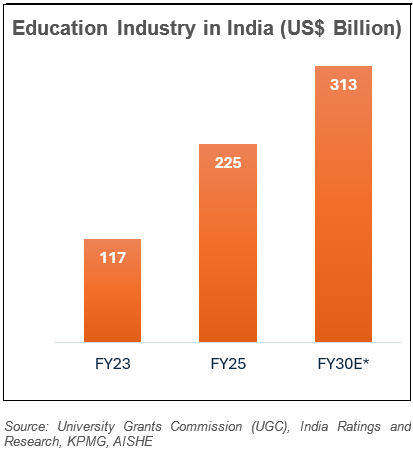
The education sector in India was worth about US$ 225 billion in FY2025 and it will be about US$ 313 billion by FY2030. India has the biggest higher education system globally with 45 million students in FY2024, while 24.69 crore students were enrolled in Indian schools in 2024–25.

Education Industry (FY25)
US$ 225 billion

Projected (FY30)
US$ 313 billion

Higher Education Enrolment (FY24)
45 million

School Students (2024-25)
24.69 crore
Introduction
India has a major presence in the education industry as well, with one of the world's largest networks of higher learning institutions. The percentage of people in India who fall in the 0-14 year age bracket is 24.20%, and hence there is great potential for development within the education industry. Moreover, India's vast English-speaking population means that the education products can easily be delivered.
From the era of Kothari Commission recommendations (1964) and the liberalization regime of the 1990s, the sector has moved on to Right of Children to Free and Compulsory Education (RTE), which came into effect in 2010, followed by National Education Policy (NEP) 2020. NEP 2020 abolishes the conventional 10+2 schooling system and introduces the new 5+3+3+4 curriculum structure with focus on Early Childhood Care and Education (ECCE).
Indian institutions of higher learning have gained more recognition internationally. According to the Times Higher Education World University Rankings 2026, India has 128 universities, thus becoming the second largest country next to the USA in terms of representation of its universities. According to the QS World University Rankings 2027, India has 52 universities, with IIT Delhi placed at 118th position. Highest ever number of Indian institutions has been reported in QS World University Rankings for Asia 2026, i.e., 294 institutions.
MARKET SIZE AND GROWTH
- India's education industry was valued at US$ 225 billion in FY25 and is projected to reach Rs. 26,94,617 crore (US$ 313 billion) by FY30.
- The higher education market, valued at Rs. 5,75,000 crore (US$ 68.06 billion) in 2024, is expected to nearly double to Rs. 11,60,000 crore (US$ 134.84 billion) by 2033, a Compound Annual Growth Rate (CAGR) of 8.10%.
- Higher education enrolment rose 16.80% from 38.50 million in FY20 to 45.00 million in FY24, comprising 22.60 million male and 22.40 million female students, and India ranks second in the world in student enrolment.
- India's edtech market was valued at Rs. 32,670 crore (US$ 3.63 billion) in 2025 and is projected to reach Rs. 2,99,790 crore (US$ 33.31 billion) by 2034, a CAGR of 28%.
- As of July 2026, India had 1,422 universities, up from 760 in FY15, and 52,432 colleges.
KEY SEGMENTS
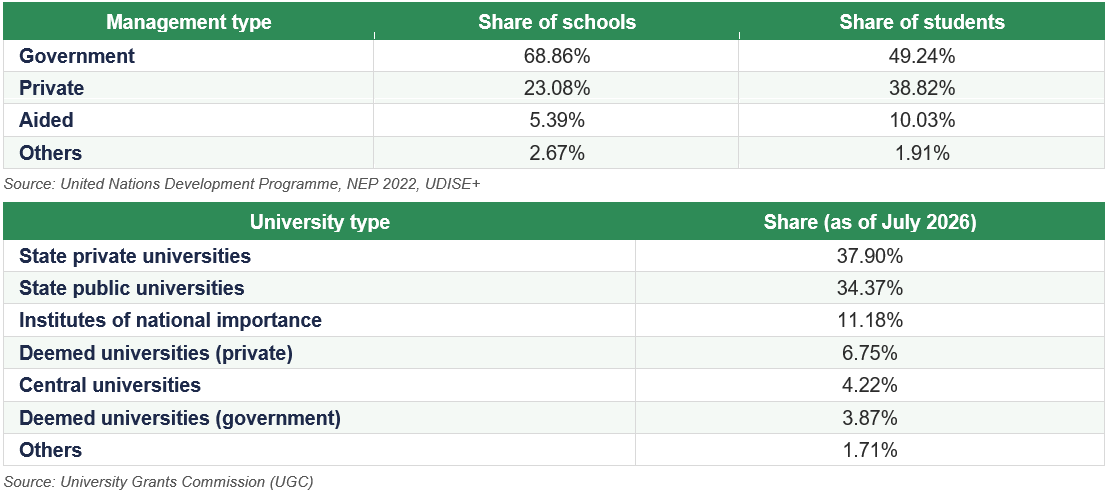
The education system in India comprises both government and private sectors. The system covers schools, preschools, higher education institutions, coaching classes, vocational training centres and educational material suppliers.
- The value of the K-12 education market in 2024 was about US$ 53 billion, while it is projected to grow at a CAGR of around 3.50% during 2024-2030.
- As per December 2022, revenue earned from coaching industry stood at Rs. 58,088 crore (US$ 7 billion) and it is expected to grow up to Rs. 1,33,995 crore (US$ 16.16 billion) by 2028.
- In India, 51.80% of universities and 54.30% of colleges are located in rural areas.
INVESTMENTS AND FDI
- The cumulative Foreign Direct Investment (FDI) equity inflow in the education sector amounted to Rs. 83,605.29 crore (US$ 11,290.86 million) from January 2000 to March 2026, which comprised 1.42% of the total FDI flow, while 100% FDI is permitted under the automatic route.
- The edtech industry has seen private equity and venture capital investments totalling over Rs. 1,23,883 crore (US$ 14.40 billion) in the period from 2015 to 2025, while edtech investments stood at US$ 178 million during H1 2026, which is more than the total investments in 2025 worth US$ 155 million.
- In September 2024, PhysicsWallah secured Rs. 1,774 crore (US$ 210 million) funding with a valuation of Rs. 23,657 crore (US$ 2.80 billion), while its initial public offering (IPO) of Rs. 3,480 crore (US$ 390 million) was listed at a premium of 33-42% in November 2025.
- Eruditus, in October 2024, got Rs. 1,267 crore (US$ 150 million) in financing from the lead investor TPG Rise, while in February 2025, upGrad got Rs. 521.10 crore (US$ 60 million) from Temasek.
GOVERNMENT INITIATIVES
- Union Budget 2026-27: Rs. 83,562.26 crore (US$ 9.45 billion) was allocated to the Department of School Education and Literacy, up 6.35%, and Rs. 55,727.22 crore (US$ 6.30 billion) to the Department of Higher Education, up 11.28%.
- Schools: Samagra Shiksha received Rs. 42,100 crore (US$ 4.68 billion), and PM SHRI, which aims to develop over 14,500 schools.
- NEP 2020: It aims for a 100% Gross Enrolment Ratio (GER) in school education, a higher education GER of 50% by 2035 from 26.30% in 2018, and vocational education for at least 50% of students by 2035.
- Pradhan Mantri Kaushal Vikas Yojana (PMKVY) 4.0: It had trained 27.08 lakh candidates across 38 sectors by December 7, 2025. • PMSETU Scheme: A Rs. 60,000 crore (US$ 6.79 billion) scheme to upgrade 1,000 Industrial Training Institutes (ITIs) through a hub-and-spoke model and train two million youth.
- IndiaAI Mission: A budget of Rs. 10,371.92 crore (US$ 1.17 billion) over five years, with Rs. 100 crore (US$ 11.11 million) for a Centre of Excellence in artificial intelligence (AI) for education.
- Digital learning: DIKSHA had over 2 crore registered users as of March 2026, and Study Webs of Active Learning for Young Aspiring Minds (SWAYAM) offered 110+ free AI courses with over 41.20 lakh enrolments.
DRIVERS AND OPPORTUNITIES
- Demographic advantage - India has the largest number of people in the age group 5-24 years in the world, totalling about 584 million and the largest school-going population in the world.
- Gap between demand and supply - India needs more than 2,00,000 schools, 35,000 colleges, 700 universities and 40 million seats for vocational training centres, while the Central and state governments spend around 4.10% of Gross Domestic Product (GDP) on education, although the prescribed figure is 6%.
- Adoption of digital technologies - Approximately 90% of homes own smartphones, 72% of children use smartphones for education purposes and 82% of institutions have adopted the practice of hybrid learning, while the online education sector market size is projected to be Rs. 65,458 crore (US$ 7.57 billion) in 2025, growing at 25.76% per annum until 2029.
- Artificial intelligence - According to PwC India, AI is expected to contribute around Rs. 49,50,000-54,63,000 crore (US$ 550-607 billion) to important sectors by 2035 and education sector would contribute around US$ 139.30-153.90 billion.
- Outreach across the globe - The Study In India initiative plans to bring over five hundred thousand international students by 2047 and Public Private Partnership (PPP) schemes are being contemplated for setting up new educational institutions.
STRATEGIES
- Supplemental methods - The company Dish TV added 32 educational channels of the Ministry of Education and Plastic Water Labs made a virtual reality system for science and mathematics.
- Joint ventures and partnerships - IIT (BHU) signed a Memorandum of Understanding (MoU) with the Government of Madhya Pradesh, GMR Aviation Academy and Emirates Group Security jointly provide courses on aviation and security, and Coursera is expanding generative AI skills through 18 universities.
- AI products - The education provider NIIT introduced an array of AI-powered products in June 2026 to enable companies to develop AI-enabled learning skills, while S Chand is focusing on AI-based data licensing apart from its K-12 publishing services.
- Scholarships and grants - In August 2025, Going Global Partnerships initiated UK-India Industry-Academia TNE Grants 2025-26, providing funding up to US$ 23,294 for projects starting on September 30, 2025.
M&A
- Approximately 85 deals worth Rs. 5,220 crore (US$ 580 million) were made in India's education industry in 2025, reflecting strategic consolidation.
- The acquisition of Unacademy by upGrad was done through a term sheet signed in March 2026 for an all-stock transaction, while the Competition Commission of India (CCI) approved the deal in July 2026.
- In January 2025, CL Educate purchased NSEIT's Digital Exam Assessment (DEX) business unit for Rs. 230 crore (US$ 26.60 million) upfront and an additional Rs. 75 crore (US$ 8.70 million) earn-out.
- NIIT purchased a 70% stake in iamneo in April 2025 and acquired SweetRush in January 2026, whereas S Chand made its first overseas acquisition in FY26 through CPD Singapore.
TRENDS
- Private education franchises - Private institutions are becoming franchises because establishing a new institution is difficult and expensive, while franchising lets operators start with less capital.
- International schools - There has been an increase of 44% in the number of authorised International Baccalaureate (IB) World Schools in India within five years, from 192 in 2020 to 276 in 2025, and they are entering tier 2 and tier 3 cities.
- India's AI skill development - India commemorated its tenth year of Skill India with Skilling for AI Readiness (SOAR), an AI skilling initiative aimed at classes 6-12 and educators; India happens to be the fastest-growing market for Coursera with 5.40 million global enrolments in generative AI in 2025.
- Edtech driven by use -India's edtech space is in a new era where the emphasis is more on usage than funding expansion, like the upGrad-Unacademy merger.
- Challenge of retention - Almost 40% of students discontinue education even after Class 10 because of socio-economic and infrastructural issues.
RECENT DEVELOPMENTS
- July 2026 : NIIT was recognised as a Market Leader in the 2026 Fosway AI Market Assessment for Digital Learning.
- March 2026 : More than 1.79 lakh ICT laboratories were approved with an investment of Rs. 7,634 crore (US$ 0.86 billion) to expand digital learning in rural, tribal and aspirational districts.
- February 2026 : IIT Madras established the IIT Madras Global Research Foundation and strengthened partnerships with Technische Universität Dresden, Carl Zeiss and Flexora.
- February 2026 : LingoAce launched ACE Academy, expanding its online learning platform to K-12 mathematics, English language arts and Mandarin Chinese.
- August 17, 2025 : The University of Delhi partnered with Google Cloud to train students in AI, cloud computing, cybersecurity and data analytics.
- May 2025 : The Indian Institute of Foreign Trade opened its first overseas campus in Dubai.

FAQs
The factors that contribute to growth include youth population, increased expenditure, NEP 2020 initiatives, digitisation, and foreign direct investment policies.
The major segments are schools, preschools, higher education, vocational training, coaching and edtech, delivered through formal and non-formal setups.
DIKSHA and SWAYAM platforms, ICT labs, hybrid and AI-based learning tools are all making education more accessible, and IIT Guwahati has created Gyandhara, a platform using VR to make mathematics and science education available in regional languages.
Support includes NEP 2020, Samagra Shiksha, PM SHRI, PMSETU, PMKVY, the IndiaAI Mission and the PM Vidyalaxmi scheme for meritorious students.
There is potential in all areas, including edtech solutions, vocational education, PPP arrangements for new institutes, and financial partnerships between foreign investors and Indian institutions.
Edtech companies are growing by providing learning through online platforms and artificial intelligence-based technologies and attracting large investments and public listings.
Skill training links learning with industrial requirements and boosts employability, while NEP 2020 combines vocational training with schools and colleges.
Thanks to the government backing and with the high use of technology and youth population in India, the country is poised to become a global hub of learning, innovation and skill development.
Related News
MORETop Indian cities for Education
- Bengaluru
- Mumbai
- New Delhi
- Hyderabad
- Chennai
- Manipal
- Kolkata
- Pune
- Kochi
- Ahmedabad


IBEF Campaigns
MORE

Case Studies
MOREHow Indian Pharmaceutical Companies Are Strengthening Their Position in Global Markets

India has become a key player in the pharmaceutical industry of the world, which can be described in terms of the following factors: large-scale manuf...
Containerisation: Transforming India's Maritime Trade

Despite other modes of transportation, the maritime shipping mode is the backbone of international trade. The concept of containerisation has revoluti...
India’s Growing Senior Care Needs: New Businesses and Services

The current state of India is characterised by the process of demographic transition with gradual growth of the proportion of senior citizens within t...
IBEF BLOG
MORE
Semiconductor Equipment and Materials: Strengthening India's Position in the Global Chip Supply Chain
The semiconductor manufacturing strategy in India is getting more comprehen...
India's Deep-Tech Startup Wave: Beyond Fintech and E-commerce
The Indian start-up eco-system, traditionally known for its focus on digita...

Investment Opportunities in India: Sectors With Strong Growth Potential
India has emerged as a potential investment destination owing to its econom...
Partners