EXECUTIVE SUMMARY
India's major ports handled cargo capacity of 914.73 Million Metric Tonnes (MMT) in FY26, with the country's 12 operational major ports and over 200 non-major ports together handling around 95% of India's trade by volume and 70% by value. India plans to invest Rs. 7,13,072 crore (US$ 82 billion) in port projects by 2035.

Cargo Capacity at Major Ports (FY26)
914.73 MMT

Port Investment Target (by 2035)
US$ 82 Billion

Major Ports (Operational)
12

Share of Trade by Volume
95%
Introduction
India's ports sector comprises major ports, governed by the Major Port Trusts Act, 1963 (except Ennore Port, under the Companies Act, 1956), and non-major (minor) ports, which come under the respective state Maritime Boards. India currently has 14 major ports, of which 12 are operational, with six new mega ports planned under the National Perspective Plan for Sagarmala.
India's maritime legacy stretches along its 11,098.81 km coastline, interspersed with more than 200 ports, positioned along the world's busiest shipping routes. Ports handle around 95% of the country's international trade volume and 70% of trade by value. From 2014 to 2025, India's port capacity across major and non-major ports almost doubled to 2,762 Million Metric Tonnes Per Annum (MMTPA).
As India moves towards becoming a US$ 5 trillion economy and realising the vision of Viksit Bharat 2047, export competitiveness through efficient port infrastructure remains a key pillar of economic transformation, with rising cargo volumes and sustained policy support strengthening the country's role as a global maritime hub.
MARKET SIZE AND GROWTH
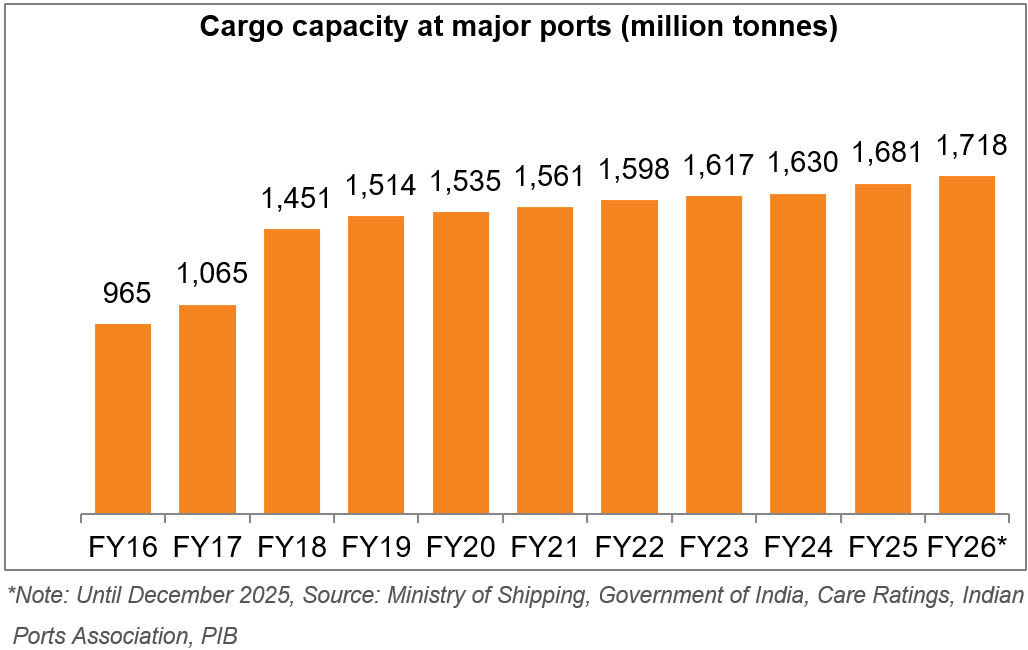
- India's cargo capacity at major ports grew to 914.73 MMT in FY26, up from 606.37 MMT in FY16, while cargo traffic reached 233.64 MMT in Q1 FY27, up 6.18% from 220.04 MMT in Q1 FY26.
- Major and non-major ports together handled around 1,602.56 MMT of cargo throughput during 2024-25, up from 1,542.88 MMT in 2023-24.
- India's container traffic reached nearly 3.99 million Twenty-Foot Equivalent Units (TEUs) in Q1 FY27, up 11.35% year-on-year (YoY), while iron ore traffic at major ports reached 14.08 MMT.
- India has plans to invest Rs. 7,13,072 crore (US$ 82 billion) in port projects by 2035, with the Government targeting Rs. 80 lakh crore (US$ 903.65 billion) in investments under Sagarmala to boost port handling capacity to 10,000 MMT by 2047.
- Merchandise exports reached US$ 89.16 billion and imports reached US$ 145.33 billion in Q1 FY27, with rising trade activity continuing to support port infrastructure demand.
KEY SEGMENTS
Major ports accounted for around 56% of India's total cargo traffic in FY26, with non-major ports gaining share.
- Deendayal Port Authority emerged as India's top major port by cargo volumes in Q1 FY27, handling 42.76 MMT (nearly 18.30% of the total), followed by Paradip Port in Odisha at 39.67 MMT (around 16.98%).
- Non-major ports accounted for 44.15% of total cargo traffic in Q1 FY27, handling 184.69 MMT.
- Total cargo handled by major ports in Q1 FY27 comprised 176.55 MMT of overseas cargo and 57.09 MMT of coastal cargo, 75.57% and 24.43% respectively.
- India’s Inland Waterways Authority of India (IWAI), under the Ministry of Ports, Shipping and Waterways, has achieved a historic milestone by recording a cargo movement of 146 million metric tonnes (MMT) in FY25, reflecting a growth of ~10% from 133 million metric tonnes (MMT) in FY24.
INVESTMENTS AND FDI
- Cumulative Foreign Direct Investment (FDI) equity inflows in the port industry stood at Rs. 6,730.91 crore (US$ 1.64 billion) between April 2000 and March 2026, with 100% FDI permitted under the automatic route for port and harbour construction and maintenance.
- At India Maritime Week 2025, investment pledges worth Rs. 12 lakh crore (US$ 135.50 billion) were signed, with approximately 30% directed toward port development and modernisation.
- The Union Budget 2025-26 introduced the Rs. 25,000 crore (US$ 2.87 billion) Maritime Development Fund (MDF), to be operationalised through the Maritime Investment Fund (MIF), an Alternative Investment Fund with a corpus of Rs. 20,000 crore (US$ 2.26 billion), featuring 49% equity from the Central Government.
- Investments in Public-Private Partnership (PPP) projects at major ports tripled from Rs. 1,329 crore (US$ 155.96 million) in FY23 to Rs. 3,986 crore (US$ 467.78 million) in FY25.
GOVERNMENT INITIATIVES
- Sagarmala Programme: Envisages 845 projects worth Rs. 6.06 lakh crore (US$ 68.58 billion); as of March 24, 2026, 315 projects worth Rs. 1.57 lakh crore (US$ 17.77 billion) have been completed, with 210 under implementation and 320 in the planning stage.
- Port modernisation: 234 projects worth Rs. 2,91,279 crore (US$ 32.96 billion) are underway, of which 106 projects worth Rs. 35,423 crore (US$ 4.01 billion) have been completed and 53 projects worth Rs. 71,956 crore (US$ 8.14 billion) are being implemented, as of December 2025.
- Sagarmala 2.0: The Government is advancing this expansion with Rs. 40,000 crore (US$ 4.65 billion) in support to drive Rs. 12,00,000 crore (US$ 139.49 billion) in investments between 2025 and 2035.
- Shipbuilding Financial Assistance Policy (SBFAP) 2.0: Extended in the Union Budget 2025-26 with an outlay of Rs. 18,090 crore (US$ 2.08 billion), alongside a Rs. 75,000 crore (US$ 8.72 billion) investment over five years to establish three shipbuilding clusters on India's east and west coasts.
- One Nation One Port Process (ONOP): Launched in February 2025 to unify documentation and processes across major ports, reducing paperwork by 33% for container and 29% for bulk cargo operations.
DRIVERS AND OPPORTUNITIES
- Rising trade volumes - Ports in India handle around 95% of the country's trade by volume and 70% by value, with rising merchandise trade continuing to drive cargo traffic growth.
- Private sector participation - Around 50% of major ports currently operate under PPPs, expected to grow to 85% over the next decade, with PPPs having contributed around Rs. 55,000 crore (US$ 6.20 billion) in investments over 25 years.
- Capacity expansion - India's ports sector is set for an estimated annual capacity addition of 500-550 Million Tonnes Per Annum (MTPA) between FY23 and FY28, driven primarily by increased handling of Petroleum, Oil and Lubricants (POL), coal and containerised cargo.
- Northeast inland waterway hub - The Northeastern Region is being established as a primary inland waterway hub, supported by an investment of Rs. 1,665 crore (US$ 188.40 million) across 20 National Waterways, including the strategically important NW-2 on the Brahmaputra.
- Competitive turnaround times - Average container dwell time at Indian ports is now less than three days, compared with four days in the UAE and South Africa, seven days in the USA and ten days in Germany.
STRATEGIES
- Green port initiatives - The Conference on Maritime Decarbonization in India, held in October 2024, reinforced India's net-zero emissions target by 2070 through initiatives such as the Harit Sagar and Harit Nauka guidelines for green ports and cleaner shipping.
- International green corridors - India and the Netherlands are collaborating to create a green digital corridor connecting Indian ports with the Port of Rotterdam for exporting green hydrogen and carriers such as ammonia and methanol, as part of India's Maritime Vision 2030.
- Fleet expansion - India plans to establish a new shipping company to expand its fleet by at least 1,000 ships over the next decade, with joint ownership by state-run oil, gas and fertilizer companies alongside the Shipping Corporation of India, targeting a one-third reduction in foreign freight outgoings by 2047.
- Shipbreaking revival - India plans to roll out Rs. 4,000 crore (US$ 454 million) in incentives over ten years from 2026 to boost its shipbreaking industry and reclaim market share from Bangladesh and Pakistan.
M&A
- In June 2026, Adani Ports and Special Economic Zone Limited (APSEZ) and Terminal Investment Limited (TiL), the terminal arm of the Mediterranean Shipping Company (MSC) Group, entered into a definitive agreement under which TiL will acquire a 49% stake in Adani Vizhinjam Port Private Limited.
- Adani Group announced an investment of Rs. 30,000 crore (US$ 3.46 billion) in February 2025 in Kerala over the next five years, focusing on infrastructure, logistics and manufacturing expansion.
- In 2024, Adani Ports acquired a 95% stake in Odisha's Gopalpur Port for Rs. 3,080 crore (US$ 369 million), enhancing its east coast presence.
- In April 2023, APSEZ completed the acquisition of Karaikal Port Private Limited for Rs. 1,485 crore (US$ 188.93 million), following its selection as the successful resolution applicant under the Corporate Insolvency Resolution Process (CIRP).
TRENDS
- Faster port turnaround - The average turnaround time at major ports has fallen from 127 hours in 2010-11 to 49.32 hours in FY26 (April-December 2025).
- Global scale ambitions - Adani Group plans a Rs. 26,088 crore (US$ 3 billion) investment over three to five years to expand global ports capacity, targeting strategic acquisitions in Europe, Africa and Southeast Asia to raise overseas revenue share to 20-25%.
- Record cargo milestones - APSEZ handled a record 500.80 MMT of cargo in FY26, an 11% YoY increase, with Mundra Port surpassing 200 million tonnes in annual cargo volume for the first time.
- Maritime heritage tourism - The Union Cabinet approved development of the National Maritime Heritage Complex at Lothal, Gujarat, in October 2024, showcasing India's 4,500-year-old maritime heritage.
- Port-led industrialisation - In FY25, 962 acres of land were allocated for port-led industrialisation, expected to generate Rs. 7,565 crore (US$ 887.80 million) and attract future investments of Rs. 68,780 crore (US$ 8.07 billion).
RECENT DEVELOPMENTS
- January 2026 : The Union Minister for Ports, Shipping and Waterways rolled out port infrastructure and digital governance projects worth Rs. 235 crore (US$ 26.59 million) at Chennai Port Authority and Kamarajar Port Limited.
- 2025 : The Union Cabinet approved construction of a six-lane greenfield highway connecting Jawaharlal Nehru Port Authority (Pagote) to Chowk, Maharashtra, at an investment of Rs. 4,500 crore (US$ 521.50 million).
- 2025 : The Ministry of Ports, Shipping and Waterways announced plans to invest over Rs. 57,000 crore (US$ 6.55 billion) to boost Kandla Port's capacity, including a mega shipbuilding project and a new cargo terminal.
- June 2024 : The Government of India approved establishment of a Major Port at Vadhavan, Maharashtra, at an estimated cost of Rs. 76,220 crore (US$ 9.14 billion), to enhance EXIM trade capacity and accommodate mega vessels.
- 2023 : The Ministry of Ports, Shipping and Waterways initiated development of a Next-Gen Container Terminal at Tuna Tekra, Gujarat, through a Rs. 4,243.64 crore (US$ 511.70 million) PPP agreement with DP World.
- 2023 : The Ministry of Ports, Shipping and Waterways launched the National Logistics Portal (Marine), connecting logistics stakeholders and enhancing efficiency through IT integration.
FAQs
The shipping industry enables the movement of goods through India's extensive maritime network of major and non-major ports. It handles nearly 95% of India's trade by volume and plays a vital role in logistics, exports, and economic growth.
Ports in India are the backbone of international trade, handling around 95% of trade by volume and 70% by value. They support exports, industrial growth, supply chains, and improve the country's global trade competitiveness.
Ports in India include 12 operational major ports such as Deendayal, Paradip, Jawaharlal Nehru Port (JNPA), Chennai, Visakhapatnam, and Mumbai. These ports handle over half of the country's total cargo traffic and support international maritime trade.
The shipping industry is expanding due to rising cargo volumes, growing merchandise exports, port modernisation, inland waterways development, private investments, and increasing demand for efficient multimodal logistics infrastructure.
Ports in India are being modernised through mechanisation, capacity expansion, deeper drafts, multimodal logistics parks, inland waterways, and greenfield projects such as Vadhavan Port. These investments are improving efficiency and reducing logistics costs.
The Government is strengthening the shipping industry through Sagarmala, Sagarmala 2.0, the Maritime Development Fund, the Indian Ports Bill 2025, ONOP, Jalvahak, and the Shipbuilding Financial Assistance Policy to enhance port capacity and maritime infrastructure.
The maritime sector in India offers investment opportunities in ports, shipbuilding, inland waterways, logistics parks, green shipping, and maritime infrastructure. Supportive FDI policies and large-scale government investments continue to attract private and global investors.
Ports in India serve as the country's primary gateways for international trade by handling the majority of export and import cargo. Efficient port operations strengthen supply chains, reduce logistics costs, and enhance India's global trade competitiveness.
The shipping industry is expected to witness sustained growth, supported by Sagarmala projects, expanding cargo capacity, green shipping initiatives, inland waterways, and major investments in port modernisation, positioning India as a leading global maritime hub.
Related News
MOREMajor Ports in India
- Kolkata
- Paradip
- Visakhapatnam
- Kamarajar (Ennore)
- Chennai
- V.O Chidambaranar
- Cochin
- New Mangalore
- Mormugao
- Deendayal
- Mumbai
- J.N.P.T



Case Studies
MOREHow Indian Pharmaceutical Companies Are Strengthening Their Position in Global Markets

India has become a key player in the pharmaceutical industry of the world, which can be described in terms of the following factors: large-scale manuf...
Containerisation: Transforming India's Maritime Trade
Despite other modes of transportation, the maritime shipping mode is the backbone of international trade. The concept of containerisation has revoluti...
India’s Growing Senior Care Needs: New Businesses and Services

The current state of India is characterised by the process of demographic transition with gradual growth of the proportion of senior citizens within t...
IBEF BLOG
MORE
Semiconductor Equipment and Materials: Strengthening India's Position in the Global Chip Supply Chain
The semiconductor manufacturing strategy in India is getting more comprehen...

India's Deep-Tech Startup Wave: Beyond Fintech and E-commerce
The Indian start-up eco-system, traditionally known for its focus on digita...

Investment Opportunities in India: Sectors With Strong Growth Potential
India has emerged as a potential investment destination owing to its econom...
Partners