EXECUTIVE SUMMARY
India's food processing market reached US$ 382.24 billion in 2025, with Gross Value Added (GVA) of US$ 27.06 billion in 2023-24. The sector drew cumulative Foreign Direct Investment (FDI) of US$ 16.15 billion between April 2000 and March 2026, and processed food and related products exports totalled US$ 28.87 billion in FY26.

Market Size (2025)
US$ 382.24 Billion

GVA (2023-24)
US$ 27.06 Billion

Processed Food and Related Products (FY26)
US$ 28.87 Billion

Cumulative FDI (2001-26)
US$ 16.15 Billion
Introduction
India's food processing industry transforms the country's vast agricultural output into higher-value dairy, poultry and meat, fisheries and marine, spices, fruits and vegetables, and ready-to-eat products. It converts raw produce into packaged, preserved and processed goods, linking farmers to consumers through a value chain of collection centres, processing units, cold chains and retail networks. India's diverse agro-climatic zones give the sector one of the world's widest raw material bases.
The sector is a key contributor to India's manufacturing and agricultural economy, accounting for around 32% of the country's total food market and ranking among India's largest industries. It is ranked fifth globally in terms of production, consumption, export and expected growth, and employs nearly 1.93 million people in the registered sector and another 5.10 million in the unregistered segment. Rising Gross Value Added, growing exports and expanding foreign investment reflect its deepening role in value addition, employment generation and farmer income growth.
Government focus on the sector has intensified under the “Make in India” initiative and the Viksit Bharat@2047 vision, which aims to scale food processing into a global hub for high-quality, value-added food products, strengthening its contribution to a developed India by 2047.
MARKET SIZE AND GROWTH
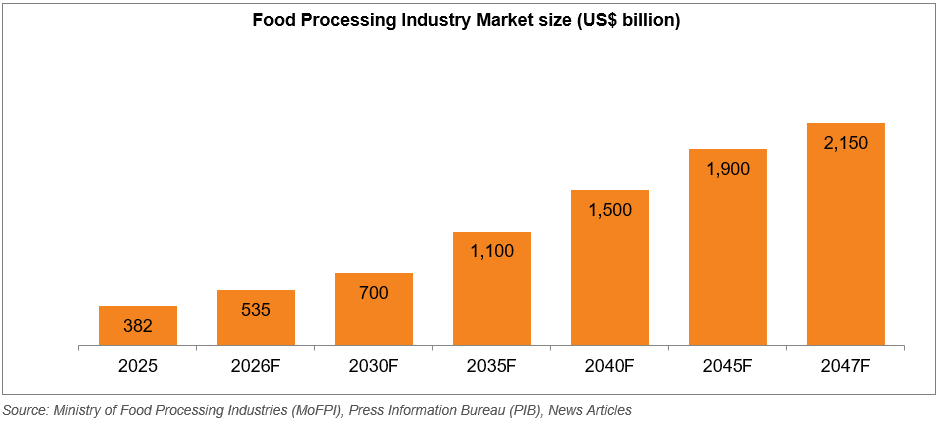
- India's food processing market size reached Rs. 33,052.50 billion (US$ 382.24 billion) in 2025 and is expected to grow at a Compound Annual Growth Rate (CAGR) of about 7.72% to Rs. 65,835 billion (US$ 689.02 billion) by 2034. Per the Viksit Bharat@2047 report, the sector is projected to reach Rs. 60,22,100 crore (US$ 700 billion) by 2030 and Rs. 1,84,96,450 crore (US$ 2,150 billion) by FY47.
- GVA rose from Rs. 1.61 lakh crore (US$ 24.60 billion) in 2015-16 to Rs. 2.24 lakh crore (US$ 27.06 billion) in 2023-24, and the Government targets Rs. 7.20 lakh crore (US$ 84.24 billion) by 2047, an implied CAGR of about 10%.
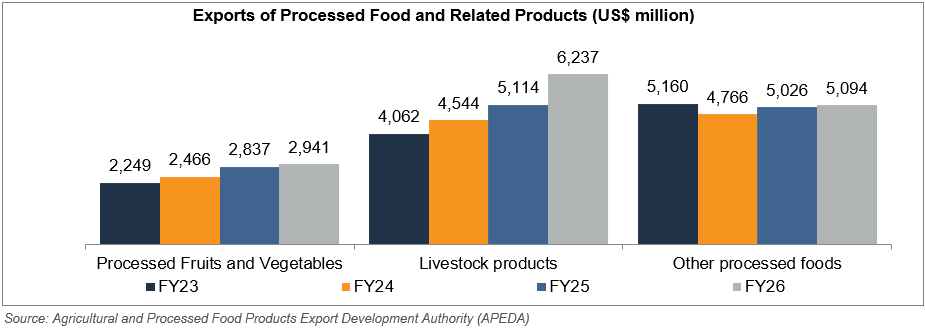
- Processed food accounted for approximately 20.40% of India's agricultural exports in 2024-25, up from 13.70% in 2014-15, and agricultural and processed food exports rose 7.17% year-on-year to Rs. 4,74,697.17 crore (US$ 53.70 billion) in FY26.
- India's food and grocery market is among the largest globally, with a retail market exceeding Rs. 95,117 billion (US$ 1.10 trillion) in 2025, and food and grocery account for about 60-70% of total retail consumption.
KEY SEGMENTS
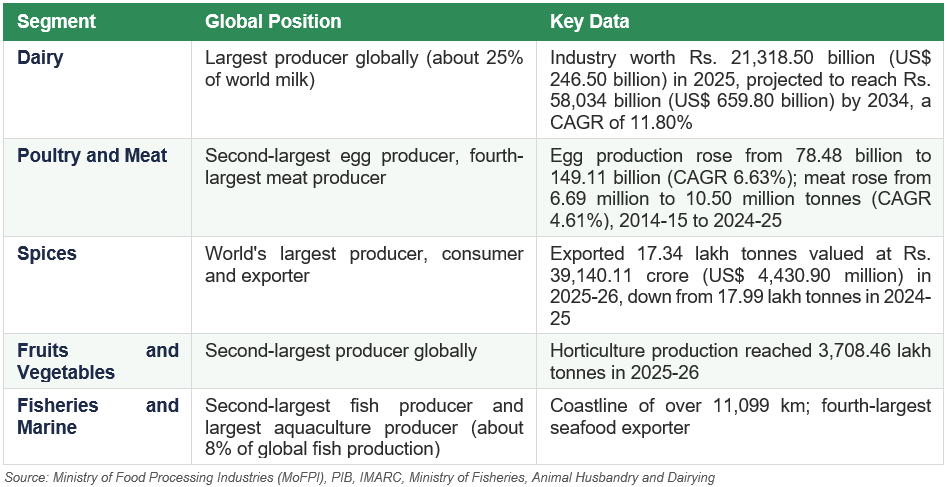
- India's milk production rose from 146.31 million tonnes in 2014-15 to 247.87 million tonnes in 2024-25, a CAGR of 5.41%, and is projected to reach 263 million tonnes in FY27.
INVESTMENTS AND FDI
- India's food processing industry received cumulative equity FDI inflows of about Rs. 1,13,107.85 crore (US$ 16.15 billion) between April 2000 and March 2026, making it the 15th-largest FDI-recipient sector and about 1.80% of the country's total cumulative FDI equity inflows over the same period.
- The Animal Husbandry Infrastructure Development Fund (AHIDF), with a total outlay of Rs. 29,610.25 crore (about US$ 3.50 billion) and a 3% interest subvention had approved 428 projects and sanctioned loans of Rs. 10,320 crore (US$ 1.19 billion) by December 2025.
- The food processing sector offers investment opportunities worth Rs. 225.79 billion (US$ 2.36 billion) across 31 projects under Common Infrastructure for Industrial Parks, covering specialised processing units, effluent treatment plants, testing laboratories, warehouses and logistics support.
- Amul announced a Rs. 600 crore (US$ 69.10 million) investment to set up the world's largest curd manufacturing facility in Kolkata, expanding its footprint in West Bengal.
GOVERNMENT INITIATIVES
- Pradhan Mantri Kisan Sampada Yojana (PMKSY): Allocation raised to Rs. 6,520 crore (US$ 745 million) for 2021-22 to 2025-26; 408 integrated cold chain projects approved, creating 10.06 lakh MT of storage and 331 MT per hour of quick-freezing capacity.
- Production Linked Incentive Scheme for Food Processing Industry (PLISFPI): Rs. 10,900 crore (US$ 1.15 billion) outlay for 2021-22 to 2026-27, targeting processed food production worth Rs. 33,494 crore (US$ 3.53 billion) and 2.50 lakh jobs.
- PM Formalisation of Micro Food Processing Enterprises (PMFME) Scheme: Supported over 59,200 micro enterprises by December 2025, mobilising investments over Rs. 17,000 crore (US$ 1.92 billion); allocated Rs. 1,700 crore (US$ 192.36 million) in Budget 2026-27.
- Mega Food Park (MFP) Scheme: A cluster-based model connecting farmers, processors and retailers via cold chains and collection centres; 41 projects approved, 25 operational as of FY26, backed by a Rs. 2,000 crore (US$ 263 million) NABARD Fund.
- PLI Scheme for Millet-Based Products (PLISMBP): Launched with an outlay of Rs. 800 crore (US$ 96 million).
- BHARATI Initiative: APEDA's Bharat's Hub for Agritech, Resilience, Advancement and Incubation for Export Enablement empowers 100 agri-food startups, targeting Rs. 4,28,450 crore (US$ 50 billion) in agri-food exports by 2030.
- Fiscal Incentives: Full profit exemption for the first five years, then a 25% (30% for companies) deduction for the next five; 100% capital expenditure deduction for cold chains; and Priority Sector Lending (PSL) classification for food and agro-processing loans.
- SPICED Scheme: Boosts turmeric exports through quality certification, value-addition support and market-linkage programmes under the newly formed National Turmeric Board.
DRIVERS AND OPPORTUNITIES
- Rising demand - India is set to remain among the world's youngest populations till 2030, and rising incomes and urbanisation continue to shift food consumption patterns.
- Competitive advantage - Diverse agro-climatic conditions give India a wide raw material base, with the country among the leading global producers of milk, spices, fruits, vegetables, poultry, meat and seafood.
- Infrastructure - India has the world's second-largest road network and fourth-largest rail network, and strategic coastal access supports trade with Europe, the Middle East, Africa and the Asia-Pacific.
- Policy support - 100% FDI is permitted in food processing under the automatic route, and the sector is a recognised priority industry under “Make in India.”
- Startup ecosystem - India's food processing sector has over 3,300 Department for Promotion of Industry and Internal Trade (DPIIT)-recognised startups across 425 districts, employing about 33,000 people.
- Rising consumption - India's food consumption is projected to reach Rs. 111.19 trillion (US$ 1.20 trillion) by CY26, offering strong headroom for processed and value-added food products.
STRATEGIES
- Capacity and distribution focus - Britannia is shifting capital spending toward maintenance after completing major capacity expansions, while aiming to raise rural markets' share of domestic sales from 40% to 50% within three to four years by expanding its direct distribution network.
- Quick-service expansion - Jubilant FoodWorks accelerated its 20-minute delivery initiative and digital ordering ecosystem to strengthen customer experience, with delivery sales growing over 20% year-on-year against food-delivery aggregators.
- Integrated poultry growth - Indian Broiler Group continued strengthening its integrated poultry operations across breeding, feed, hatcheries, farming and processing, driven by rising protein consumption and demand for processed chicken.
M&A
- Jubilant FoodWorks entered an agreement to sell its entire 31.66% stake in Hashtag Loyalty, with completion expected by February 2026, as part of portfolio rationalisation.
- In July 2025, Jubilant Bhartia Group completed the acquisition of a 40% stake in Hindustan Coca-Cola Holdings.
- In December 2022, Britannia Industries formed a joint venture with French cheesemaker Bel Group to scale up its packaged cheese business five-fold to about Rs. 1,250 crore (US$ 152.90 million) over five years, holding a 51% stake to Bel Group's 49%.
TRENDS
- Global Hub for Millets - Following the United Nations General Assembly's declaration of 2023 as the International Year of Millets, India is positioning itself as a Global Hub for Millets (Shree Anna); the Indian Institute of Millets Research, Hyderabad, has been designated a Centre of Excellence, and India hosted a Global Millets Conference with over 102 countries during its Group of Twenty (G20) presidency.
- Health-driven innovation - Rising demand for better-for-you formats is prompting product innovation, such as Britannia's early entry into millet bread and Domino's India's millet-crust pizza, in line with national efforts to promote millet consumption.
- Trade policy tailwinds - Recent GST reforms and continued export market-diversification efforts are expected to sustain strong momentum in India's agricultural and processed food exports into FY27.
RECENT DEVELOPMENTS
- May 2026 : Britannia announced Q4 and FY26 results: consolidated sales grew about 7%; net profit rose over 20% year-on-year to nearly Rs. 678 crore (US$ 76.72 million), with a final dividend of Rs. 90.50 (US$ 1.02) per share.
- May 2026 : Jubilant FoodWorks announced Q4 and FY26 results: consolidated revenue grew 19.30% year-on-year to about Rs. 2,499 crore (US$ 282.79 million), net profit surged 66%, and the company added 69 new stores, taking its network past 3,600 outlets.
- December 2025 : Indian Broiler Group participated in Poultry India 2025, one of South Asia's largest poultry exhibitions.
- September 2025 : World Food India 2025, hosted by MoFPI and inaugurated by Prime Minister Narendra Modi, positioned India as a Global Food Hub with over 90 participating countries and 2,000 exhibitors.
- August 2025 : Britannia Industries cut its FY26 capital expenditure to Rs. 100 crore (US$ 11.40 million), a 77% cut from FY25, shifting focus to maintenance after completing major expansions.
- August 2025 : Jubilant FoodWorks announced plans to expand its Domino's Pizza and Popeyes presence across India, targeting a 200 basis-point margin gain.
FAQs
The food processing industry in India transforms agricultural produce into value-added food products such as dairy, beverages, processed fruits and vegetables, meat, seafood, cereals, and packaged foods. It is a key pillar of India's agri-economy.
The food processing sector strengthens agriculture by creating value addition, generating employment, boosting exports, and reducing food wastage. Processed food accounted for approximately 20.4% of India's agricultural exports in FY2024-25, up from 13.7% in FY2014-15, reflecting the sector's growing role in value addition and exports.
The food industry in India includes dairy products, processed fruits and vegetables, meat and poultry, seafood, cereals, beverages, spices, packaged foods, ready-to-eat (RTE), ready-to-cook (RTC), and confectionery. These segments cater to both domestic and export markets.
The food processing sector is expanding due to rising urbanisation, changing food habits, increasing organised retail, higher exports, abundant agricultural production, growing cold chain infrastructure, and strong government support for value-added food manufacturing.
The food processing industry in India reduces post-harvest losses by extending shelf life through cold chains, food preservation, packaging, warehousing, and value addition. This improves farmer incomes, strengthens food security, and enhances supply chain efficiency.
The Government is supporting the food processing sector through PM Kisan SAMPADA Yojana (PMKSY), PMFME, PLISFPI, Mega Food Parks, One District One Product (ODOP), AHIDF, and 100% FDI under the automatic route.
The food processing industry in India offers investment opportunities across dairy, packaged foods, beverages, cold chain logistics, food testing, agro-processing, food technology, ready-to-eat products, and export-oriented food manufacturing. Strong FDI inflows and policy support continue to attract investors.
The food processing sector continues to focus on strengthening cold chain infrastructure, improving logistics, reducing food wastage, ensuring quality standards, and expanding value-added processing. Continued investments in technology and infrastructure will support long-term growth.
Technology is transforming the food processing industry in India through automation, smart food processing, cold chain solutions, food irradiation, quality testing, AI-enabled supply chains, and traceability systems. These innovations improve efficiency, food safety, and export competitiveness.
The food processing industry in India is expected to witness robust long-term growth, supported by rising consumption, agricultural value addition, exports, and government initiatives. The market is projected to reach US$ 700 billion by 2030, strengthening India's position as a global food processing hub.
Related News
MOREIBEF Campaigns
MORE

Case Studies
MOREHow Indian Pharmaceutical Companies Are Strengthening Their Position in Global Markets

India has become a key player in the pharmaceutical industry of the world, which can be described in terms of the following factors: large-scale manuf...
Containerisation: Transforming India's Maritime Trade

Despite other modes of transportation, the maritime shipping mode is the backbone of international trade. The concept of containerisation has revoluti...
India’s Growing Senior Care Needs: New Businesses and Services

The current state of India is characterised by the process of demographic transition with gradual growth of the proportion of senior citizens within t...
IBEF BLOG
MORE
Semiconductor Equipment and Materials: Strengthening India's Position in the Global Chip Supply Chain
The semiconductor manufacturing strategy in India is getting more comprehen...

India's Deep-Tech Startup Wave: Beyond Fintech and E-commerce
The Indian start-up eco-system, traditionally known for its focus on digita...
Investment Opportunities in India: Sectors With Strong Growth Potential
India has emerged as a potential investment destination owing to its econom...
Partners