EXECUTIVE SUMMARY
India's automobile industry produced 34.71 million vehicles in FY26 and sold 28.26 million units in the domestic market, while exports reached 6.65 million units. Electric vehicle (EV) sales grew 30% to 2.66 million units in FY26. In Q1 FY27, the total number of passenger vehicles, commercial vehicles, three-wheelers, two-wheelers, and quadricycles sold in India was 73,81,656 units. India accomplished a significant milestone, with the sale of 8,67,491 Electric Vehicles in Q1 FY27.

Market Size (2026)
US$ 26.53 billion

CAGR (2026-2031)
6.66%

Union Budget Allocation (FY27)
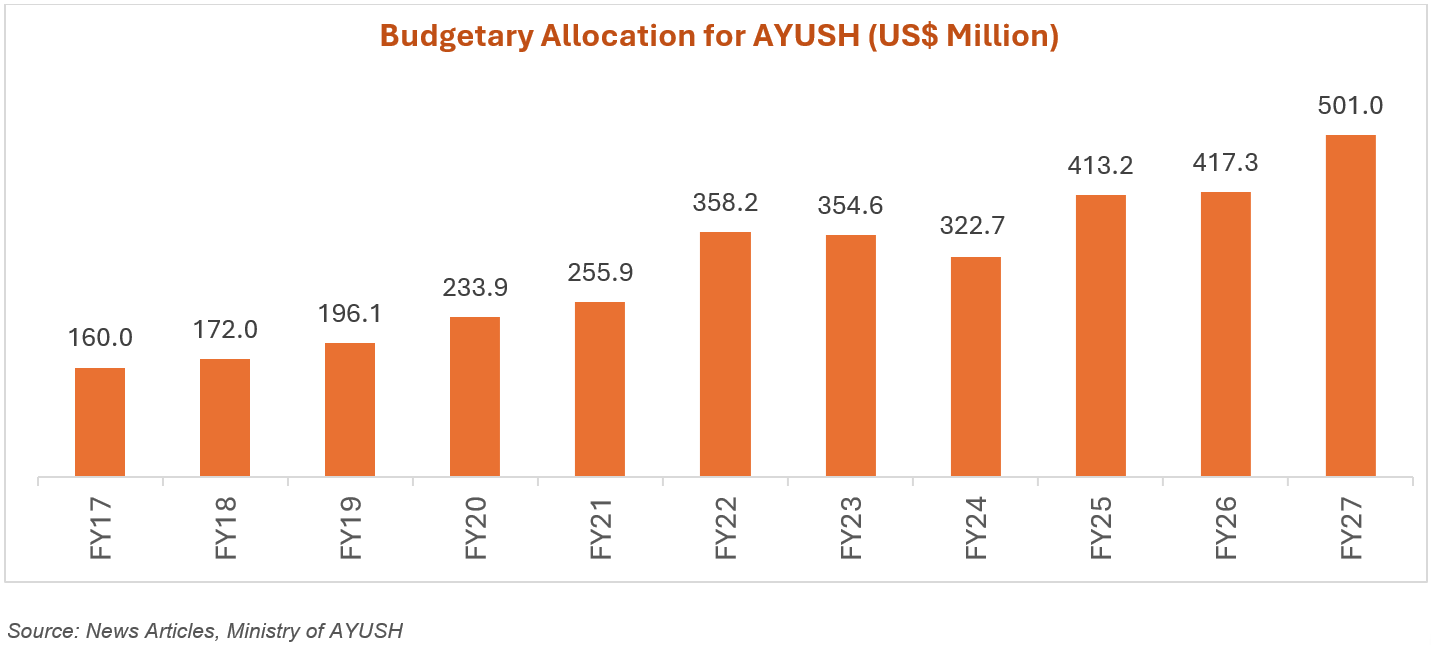
US$ 501 million

Registered Practitioners
7,51,768
Introduction
The Indian AYUSH industry has experienced remarkable development in the recent past, establishing itself as a major industry based on its earnings and manpower. AYUSH covers various traditional medicine systems including Ayurveda, Yoga, Unani, Siddha, and Homeopathy. The Indian AYUSH industry is developing very fast due to rising awareness, demands for natural healing systems, and government support towards traditional medicine systems.
The AYUSH healthcare delivery mechanism in India is categorised into two types - the public and the private. The public aspect involves the promotion and provision of AYUSH services through government agencies in the country, whereas the private aspect plays an important role in providing specialised treatments and herbal products. The AYUSH industry in India is characterised by the presence of an excellent legacy of healing traditions and a large number of experts, along with a relatively cheaper cost of treatment which makes it attractive for people looking for alternative medicine treatments. The growth in the industry is fuelled by the rising popularity of alternative medicine among consumers, government support, and export opportunities.

The industry plays an important role in influencing India's health care industry due to the substantial increase in the number of AYUSH colleges from 334 in 2014 to 1,137 currently. There are a total of 7,51,768 AYUSH registered practitioners in addition to the presence of hospitals and dispensaries all over India.
MARKET SIZE AND GROWTH
- India's AYUSH market was valued at Rs. 2.33 lakh crore (US$ 26.53 billion) in 2026, projected to reach Rs. 3.37 lakh crore (US$ 36.62 billion) by 2031, at a CAGR of 6.66%.
- India's exports of AYUSH and herbal products stood at 126.27 million kgs, valued at Rs. 5,644.62 crore (US$ 638.71 million), in FY26.
- Wellness tourism, valued at Rs. 1,64,164 crore (US$ 19.43 billion) in 2024, is projected to reach Rs. 2,57,237 crore (US$ 29.88 billion) by 2031.
- The Ayurvedic products market reached Rs. 62,600 crore (US$ 7.84 billion) in 2022 and is projected to reach Rs. 1,82,400 crore (US$ 21.19 billion) by 2028, at a CAGR of 19.30%.
KEY SEGMENTS
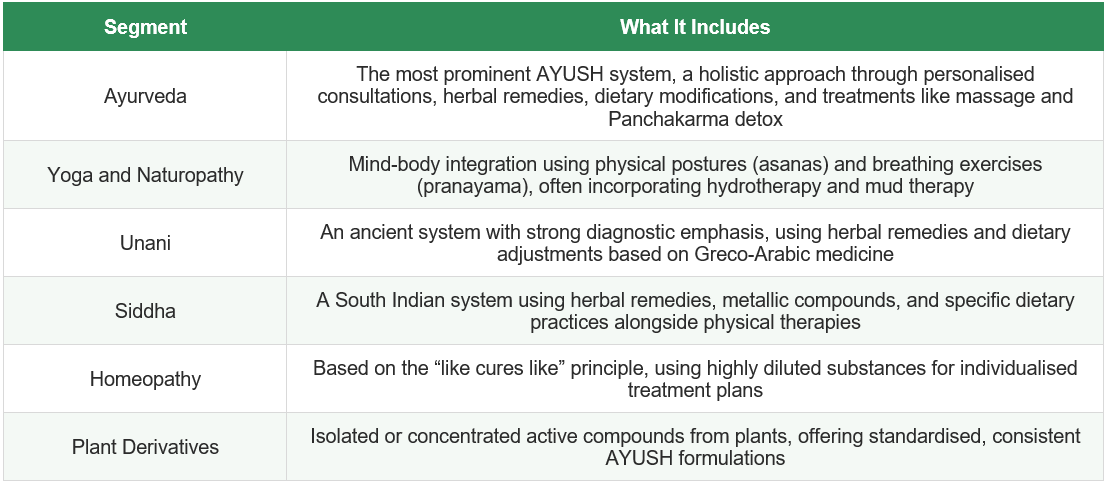
The AYUSH industry operates on the basis of six components that provide different ways of holistic health.
INVESTMENTS AND FDI
- 100% foreign direct investment (FDI) is permitted in the AYUSH sector through the automatic route.
- The Patanjali Group has announced that it will set up a Rs. 1,600 crore (US$ 185 million) Food and Herbal Park in the Yamuna Expressway Industrial Development Authority (YEIDA) region. This project is estimated to generate employment opportunities for more than 3,000 people.
- Uttar Pradesh government is providing a 30% capital subsidy on investments made in AYUSH wellness centres and resorts.
- The National Medicinal Plants Board was allotted Rs. 18.16 crore (US$ 2.10 million) in FY27 to strengthen the cultivation, conservation and supply chain infrastructure for medicinal plants.
- The Ayush Nivesh Saarthi portal acts as a platform to facilitate investment in the AYUSH domain.
GOVERNMENT INITIATIVES
- National AYUSH Mission (NAM): in 2014, the NAM provides central government funding to States and UTs for setting up AYUSH Hospitals integrated with 10, 30, and 50 beds and having adequate diagnostic facilities.
- Ayushman Arogya Mandir (AYUSH) Initiative: Approved by the Union Cabinet in March 2020, this initiative seeks to set up 12,500 holistic wellness centers under Ayushman Bharat program with objective of reducing disease burden, lowering healthcare costs and increasing preventive and wellness interventions.
- AOGUSY Quality Assurance Scheme: Under the AOGUSY scheme, quality and regulatory infrastructure for AYUSH drugs and formulations is improved. The allocation in fiscal year 2025 is Rs. 11.46 crore (US$ 1.3 million) to be utilised for ensuring drug quality assurance, standardization and monitoring. • National Medicinal Plants Board (NMPB): The National Medicinal Plants Board promotes cultivation, conservation, supply of quality planting material and value chain development of medicinal plants used in AYUSH formulations.
- NCISM and NCH Acts, 2020: The NCISM and NCH Acts of 2020 modernize AYUSH education regulation by replacing existing laws. The Acts seek to improve efficiency, transparency and standardization in AYUSH education on a large scale.
- International Cooperation Scheme: The International Cooperation scheme helps in globalizing traditional medicine of India through international collaborations in research, education and regulation.
- Ayush Nivesh Saarthi Portal: The Ayush Nivesh Saarthi Portal serves as investment facilitation platform in the area of AYUSH. Announced by Ministry of AYUSH in July 2026, it helps in enhancing investment in AYUSH ecosystem
DRIVERS AND OPPORTUNITIES
- Policy backing - 100% FDI is allowed under the automatic route, while the Ayushman Arogya Mandir scheme has increased the beneficiaries from 1.50 crore in 2021 to 11.50 crore in 2025.
- Increasing demand - The increasing interest of consumers in health-care and herbal products further increases the customer base of the AYUSH market.
- International interest is increasing - Partnerships with the World Health Organization, Germany, and Mauritius are advancing international research, regulatory cooperation, and market entry of traditional medicine.
- Opportunities for investments - Ayush Nivesh Saarthi platform and the MoU signed between AYUSHEXCIL and Zepto have increased the possibilities of digital marketing and investment for AYUSH industry manufacturers, especially MSMEs.
STRATEGIES
- Standardisation and quality assurance - Through the National Medicinal Plants Board, there is provision of genuine and high-quality medicinal plant materials for use in AYUSH products.
- Technology for growth - Ministry of Ayush signed MoU with Digital India BHASHINI Division to deploy AI enabled multilingual features within the Ayush Grid ecosystem.
- Skill development and entrepreneurship - National Skill Development Corporation's (NSDC) AYUSH Mission has helped develop more than 4.50 lakh AYUSH practitioners, whereas SPIRE-AYUSH helps develop start-ups and MSMEs.
- Growing budgetary allocation - The government's support is becoming more pronounced, with the budgetary allocation growing 20.10% from FY26 to FY27.
M&A
- Patanjali Ayurved received IRDAI's approval to buy a 73.60% equity share in Magma General Insurance for nearly Rs. 4,500 crore, thereby venturing into the financial sector.
- The Ayurvedic personal care and wellness company named Sesa Care was acquired by Dabur for an enterprise value of Rs. 325 crore (US$ 28.96 million) to increase its footprint in the Ayurvedic hair oil segment.
TRENDS
- Increasing demand for preventive and holistic health care - about preventive healthcare has increased the demand for customised AYUSH therapy programmes.
- Integration with modern healthcare - The AYUSH centres have been established alongside Primary Health Centres, Community Health Centres, and District Hospitals as per the National Ayush Mission.
- Digital transformation - E-Charak Portal upgrade along with the Ayush Grid is enhancing traceability and availability within the medicinal plants supply chain.
- Increasing global interest - 25 country-level MoUs, 52 institute-level agreements, and setting up of 43 AYUSH Information Cells in 39 countries.
- Wellness tourism emerging trend - The formation of five regional medical hubs that will have AYUSH centres, diagnostics, and rehabilitation facilities, along with three All India Institutes of Ayurveda.
- Entrepreneurial culture on the rise - With 900 DPIIT-recognised startups in AYUSH industry, MSME enterprises have witnessed a growth of almost 40% in over one year.
RECENT DEVELOPMENTS
- July 28, 2026 : Patanjali Ayurved received IRDAI approval to acquire a 73.60% stake in Magma General Insurance
- July 15, 2026 : NMPB and Delhi University's Bhaskaracharya College signed an MoU on medicinal plants research and technology transfer
- July 7, 2026 : Dabur India reported 5% revenue growth, expanding via premium offerings and quick commerce
- May 14, 2026 : The Ministry of Ayush signed an MoU with the Digital India BHASHINI Division for AI-powered multilingual capabilities
- October 30, 2025 : Dabur launched Dabur Ventures to invest in consumer-centric startups
- August 11, 2026 : The Government approved a new Government Ayurvedic Medical College in Mayurbhanj, Odisha, under the National Ayush Mission
FAQs
Increasing demands for preventive healthcare, increasing insurance coverage, and government backing have ensured its progress. This industry showed an increase of 15 times during the last ten years (2015-2025).
The industry operates via six components, namely Ayurveda, Yoga & Naturopathy, Unani, Siddha, Homeopathy, and Plant Derivatives, which provide their own way to achieve wellness.
AYUSH provides health cover to more than 600 million people and enhances primary care by having its own network of healthcare centres across the country known as Ayushman Arogya Mandirs.
Important projects being undertaken include the National AYUSH Mission, the Ayushman Arogya Mandir project, the AOGUSY quality system, and the National Medicinal Plants Board. In addition, 100% FDI is permitted through the automatic route.
There is an array of opportunities including wellness tourism, medicinal plant farming, digital health platforms, and manufacturing, facilitated through the Ayush Nivesh Saarthi portal and fully automatic-route FDI.
Ayurveda, being the most popular AYUSH system, is holistic in nature owing to personalised consultations and herbs. Market for Ayurvedic products, itself, is expected to rise from US$ 7.84 billion in 2022 to US$ 21.19 billion by 2028.
Systems like Ayush Grid, e-Charak portal, and artificial intelligence systems like SAHI and NAMASTE are revolutionising health care service and tracking its supply chain using an MoU between Ministry of Ayush and India AI.
With continuous government support and increasing global demand, the AYUSH sector is expected to expand from US$ 26.53 billion to US$ 36.62 billion during 2026-31, growing at a CAGR of 6.66%.
Related News
MOREAviation India / Major Airports
- Delhi
- Mumbai
- Chennai
- Bengaluru
- Kolkata
- Hyderabad

IBEF Campaigns
MORE

Case Studies
MOREHow Indian Pharmaceutical Companies Are Strengthening Their Position in Global Markets

India has become a key player in the pharmaceutical industry of the world, which can be described in terms of the following factors: large-scale manuf...
Containerisation: Transforming India's Maritime Trade

Despite other modes of transportation, the maritime shipping mode is the backbone of international trade. The concept of containerisation has revoluti...
India’s Growing Senior Care Needs: New Businesses and Services

The current state of India is characterised by the process of demographic transition with gradual growth of the proportion of senior citizens within t...
IBEF BLOG
MORE
Semiconductor Equipment and Materials: Strengthening India's Position in the Global Chip Supply Chain
The semiconductor manufacturing strategy in India is getting more comprehen...

India's Deep-Tech Startup Wave: Beyond Fintech and E-commerce
The Indian start-up eco-system, traditionally known for its focus on digita...

Investment Opportunities in India: Sectors With Strong Growth Potential
India has emerged as a potential investment destination owing to its econom...
Partners