EXECUTIVE SUMMARY
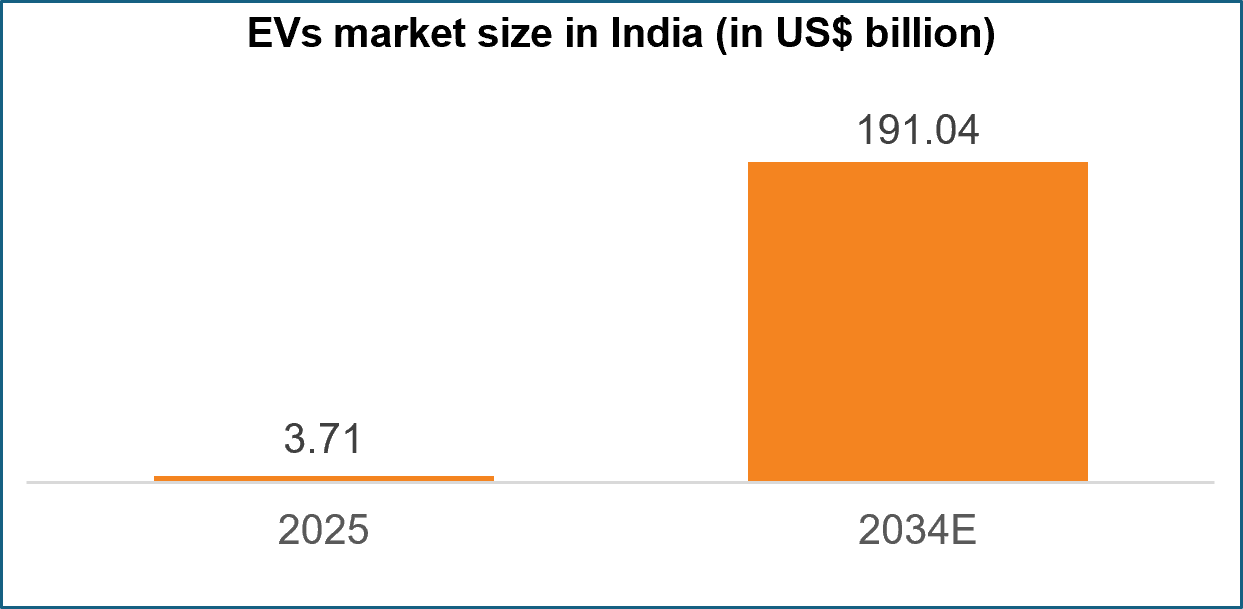
The Indian electric vehicles (EV) market was valued at US$ 3.71 billion and will reach US$ 191.04 billion in 2034, with a compound annual growth rate (CAGR) of the Indian market of 54.94%, according to IMARC Group. In FY26, the sales volume of EVs in India grew to 2,658,798 units, which indicates that the penetration rate of EVs in total auto sales is 8.62%. Two-wheelers and three-wheelers account for 87% out of the total volume of EVs. Government targets in terms of EV share composition are as follows: Private cars 30%, Commercial vehicles 70%, Buses 40%, Two-wheelers & Three-wheelers 80%.

Market Size (2025)
US$ 3.71 Billion

Projected Market Size (2034)
US$ 191.04 Billion

CAGR (2026-2034)
54.94%

EV Sales (FY26)
26.58 Lakh Units
Introduction
The EV market in the Indian subcontinent has immense potential for its growth in the coming years till 2030 with many companies focusing on this particular market segment. The reason behind this is the active involvement of the government in this field. The sale of EVs in India increased in FY26 to 2.66 million units from 2.05 million in FY25, registering YoY growth of 29.67%, up from 22.02% in FY25.
Globally, the market size of electric vehicles stands at US$ 917.30 billion in 2025 and will further grow to around US$ 4,886.20 billion by 2034, at a CAGR of 20.43% during 2026-34. Among this, the growth rate of EV market of India is much higher due to the favorable government policies, better charging stations, and common objective of minimizing carbon emissions.
Overall, the mobility market of India is expected to exceed Rs. 51,92,400 crore (US$ 600 billion) by 2030 due to the penetration of the electric vehicle, where the EV adoption in two-wheelers is expected to be 35-40%, and the EV adoption in four-wheelers is expected to be 15-17%.
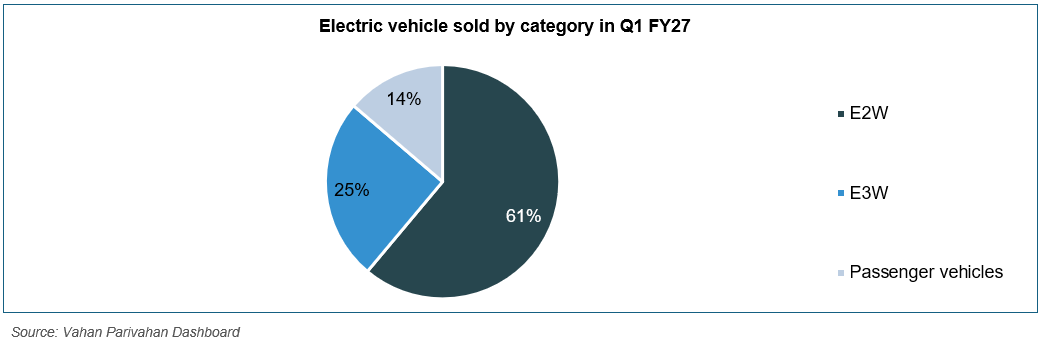
Such kind of trajectory, as stated by CII, is equal to the aggressive target of 80 million EVs by 2030 in India. The EV segment is led by two-wheelers and three-wheelers, which constitute around 86.25% of total EV sales in Q1 FY27, while electric passenger vehicles amounted to around 1,18,265 units in the same period. The EV segment is led by two-wheelers and three-wheelers, which constitute around 86.25% of total EV sales in Q1 FY27, while electric passenger vehicles amounted to around 1,18,265 units in the same period.
MARKET SIZE AND GROWTH
- The electric vehicle market value in India was estimated at US$ 3.71 billion in 2025 and expected to reach US$ 191.04 billion by 2034, at a CAGR of 54.94%.
- In India, EV sales reached 26,58,798 units in FY26, registering a growth of 29.67%, and overall registration of 8,66,918 units in Q1 FY27.
- The Indian mobility market is expected to cross US$ 600 billion mark by 2030, with EVs playing a vital role.
- Sales of luxury electric vehicles in India increased by 84% in 2025 compared to 2024, going from 5,780 units to 10,656 units.
KEY SEGMENTS
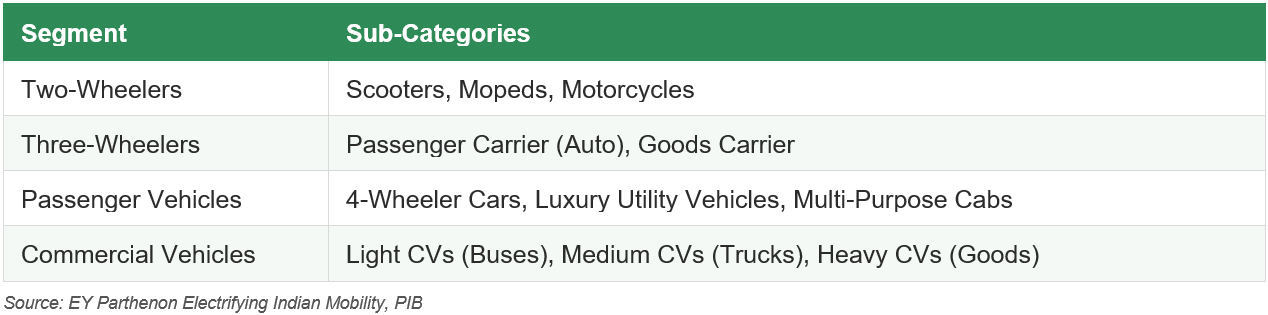
India's electric vehicles market covers four major vehicle categories:
Two-wheelers have taken the lead among EVs:
INVESTMENTS AND FDI
- The automotive industry has received cumulative equity FDI inflow of around Rs. 2,70,230.31 crore (US$ 40.31 billion) in the period April 2000-March 2026.
- India's Electric Vehicle market received around Rs. 2.23 lakh crore (US$ 25.60 billion) of investment from 2020-2025, which was about 18% of the total investment needed by 2030.
- Investment up to 2030 towards the manufacturing of electric vehicles and setting up charging stations would be around Rs. 12.50 lakh crore (US$ 180 billion).
- Tata Motors will spend about Rs. 18,000 crore (US$ 2.16 billion) in setting up its EV ecosystem, with an estimated 30-40% contribution from EVs to its sales by FY30.
- VinFast inaugurated its first overseas manufacturing facility in Thoothukudi, Tamil Nadu, with a phased investment of Rs. 16,000 crore (US$ 1.83 billion).
GOVERNMENT INITIATIVES
- PM E-DRIVE Scheme: The government has notified the PM E-DRIVE scheme with a budget of Rs. 10,900 crore (US$ 1.30 billion), set to run from October 1, 2024, to March 31, 2026. It aims to boost electric vehicle adoption, charging infrastructure, and EV manufacturing in India.
- FAME India Phase-II: In Phase-II of the FAME India scheme, the Ministry of Heavy Industries (MHI) approved a capital subsidy of Rs. 800 crore (US$ 96.13 million) to set up 7,432 Electric Vehicle Public Charging Stations (EVPCS).
- Phased Manufacturing Programme (PMP): Phased Manufacturing Programme (PMP) was launched to boost local production of EVs and their components, with incentives limited to vehicles meeting PMP norms.
- Electric Mobility Promotion Scheme: A scheme with a budget of Rs. 778 crore (US$ 93.5 million) ran for six months from April 1, 2024, to September 30, 2024. The initiative offered incentives to purchasers of electric two-wheelers (e-2W) and electric three-wheelers (e-3W).
- PM-eBus Sewa Scheme: The Ministry of Housing and Urban Affairs launched the PM-eBus Sewa Scheme on August 16, 2023, with a Rs. 20,000 crore (US$ 2.28 billion) support to deploy 10,000 electric buses through the PPP model. By March 2026, 10,000 e-buses had been sanctioned across 26 states and union territories.
DRIVERS AND OPPORTUNITIES
- Increasing demands - Indian auto manufacturers launched 18 new models of electric vehicles, increasing the sale by 16-17%, reaching 2.38 million units, which is 8% of the market share.
- Increasing investments - The Indian electric vehicle industry received ~Rs. 2.23 lakh crore (US$ 25.60 billion) of investments from 2020 to 2025, amounting to 18% of the total investment required by 2030.
- Policy support - The GST for electric vehicles is now down from 12% to 5% and the GST for EV chargers and charging stations is down from 18% to 5%.
- Opportunities - India has many opportunities within its auto components industry in that it seeks to achieve US$ 100 billion in exports from this sector by the year 2030, positioning India as a global hub for component sourcing.
STRATEGIES
- Battery and cell localisation - Ola Electric plans to develop its own cell manufacturing capacity (Bharat Cell) and aims for 5 GWh capacity at the end of FY2026, up from its current capacity of 1.4 GWh.
- Expansion of charging infrastructure - Statiq has reached 100 cities, with more than 10,000 EV charging stations; 3,000 more were added in 2025.
- Strategic technology partnerships - Ather Energy collaborated with Infineon Technologies of South Korea in order to improve the semiconductors of light electric vehicles.
- Innovation in digital space - The super app by BHEL for EV started beta testing in January 2026 across 10 states, offering real-time charger booking with 85% uptime and over 50,000 users.
M&A
- Hero MotoCorp is investing up to Rs. 275 crore (US$ 30.30 million) into electric vehicles maker Euler Motors, giving it a stronghold in the segment of electric three-wheelers and four-wheelers.
- Ather Energy raised Rs. 600 crore (US$ 71 million) through the National Investment and Infrastructure Fund, which valued the company at US$ 1.30 billion, marking its emergence as the fourth unicorn in 2023 for India.
TRENDS
- Increase in luxury EV sales - The sales of luxury EVs increased by 84% to 10,656 units in 2025 from 5,780 units in 2024.
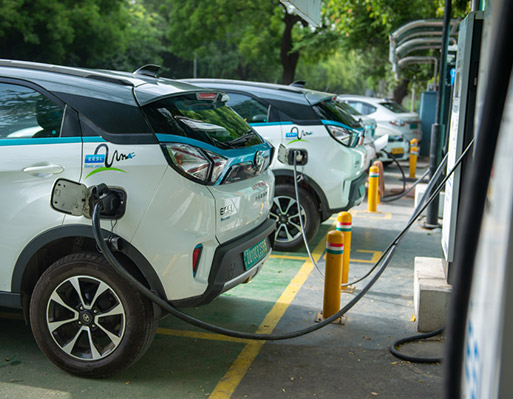
- Increasing charging stations - As of December 2025, there were 29,151 public charging stations in India, with Karnataka having 6,096 charging stations.
- Battery localisation push - Ola Electric, Panasonic, and IndianOil are focusing on localised manufacture of cells and batteries.
- Increasing state policies for EV - There are states like Bihar, Tamil Nadu, Karnataka, and Madhya Pradesh which have EV-specific policies.
- EV super-apps take off - Apps such as the BHEL EV super app and Statiq are bringing digitalisation to charger location, booking, and payment.
- Increase in EV financing - With an increase in EV financing, EVs are becoming more affordable for both individual and fleet buyers.
RECENT DEVELOPMENTS
- July 2026 : Hero MotoCorp's VIDA electric mobility brand entered the Nepal market, marking its first international expansion
- May 2026 : TATA.ev launched the Curvv.ev SeriesX, with prices starting at Rs. 16.99 lakh (US$ 17,909)
- April 2026 : Ola Electric launched the Ola S1 X+ (5.2 kWh) scooter with a claimed IDC-certified range of 320 km
- January 2026 : BHEL's EV super app commenced beta testing across 10 states, enabling real-time charger reservations
- August 2025 : VinFast opened its first overseas plant in Thoothukudi, Tamil Nadu, marking its third facility globally
- July 2025 : DPIIT signed an MoU with Ather Energy to boost India's EV and manufacturing startup ecosystem
FAQs
EVs sales in India stood at 26,58,798 units in FY26, registering an increase of 29.67%, while two-wheelers and three-wheelers contributed 88.25% to overall EV volumes.
The major initiatives include the PM E-DRIVE Scheme, FAME India Phase-II, PM-eBus Sewa Scheme, and Automotive Mission Plan 2026.
The market value of India's EVs reached US$ 3.71 billion in 2025, which is expected to increase to US$ 191.04 billion by 2034 with a CAGR of 54.94%.
GST on electric vehicles has come down to 5% from 12%, while GST on EV chargers has also been reduced to 5% from 18%, alongside state-level purchase incentives and subsidies.
In India, there were 29,151 public charging stations as of December 2025, with the government targeting approximately 72,000 new EV chargers by FY26, including 22,100 fast chargers for cars.
Two-wheelers and three-wheelers represent most of the demand for EVs at 86.25% of total EV sales in Q1 FY27, with the next biggest market being passenger vehicles and commercial vehicles.
Some of the key programmes launched are the Phased Manufacturing Programme (PMP) under FAME-II, the PM E-DRIVE Scheme, and manufacturing policies of states like Tamil Nadu and Bihar.
Related News
MOREIBEF Campaigns
MORE

Case Studies
MOREHow Indian Pharmaceutical Companies Are Strengthening Their Position in Global Markets

India has become a key player in the pharmaceutical industry of the world, which can be described in terms of the following factors: large-scale manuf...
Containerisation: Transforming India's Maritime Trade

Despite other modes of transportation, the maritime shipping mode is the backbone of international trade. The concept of containerisation has revoluti...
India’s Growing Senior Care Needs: New Businesses and Services

The current state of India is characterised by the process of demographic transition with gradual growth of the proportion of senior citizens within t...
IBEF BLOG
MORE
Semiconductor Equipment and Materials: Strengthening India's Position in the Global Chip Supply Chain
The semiconductor manufacturing strategy in India is getting more comprehen...
India's Deep-Tech Startup Wave: Beyond Fintech and E-commerce
The Indian start-up eco-system, traditionally known for its focus on digita...
Investment Opportunities in India: Sectors With Strong Growth Potential
India has emerged as a potential investment destination owing to its econom...
Partners