EXECUTIVE SUMMARY
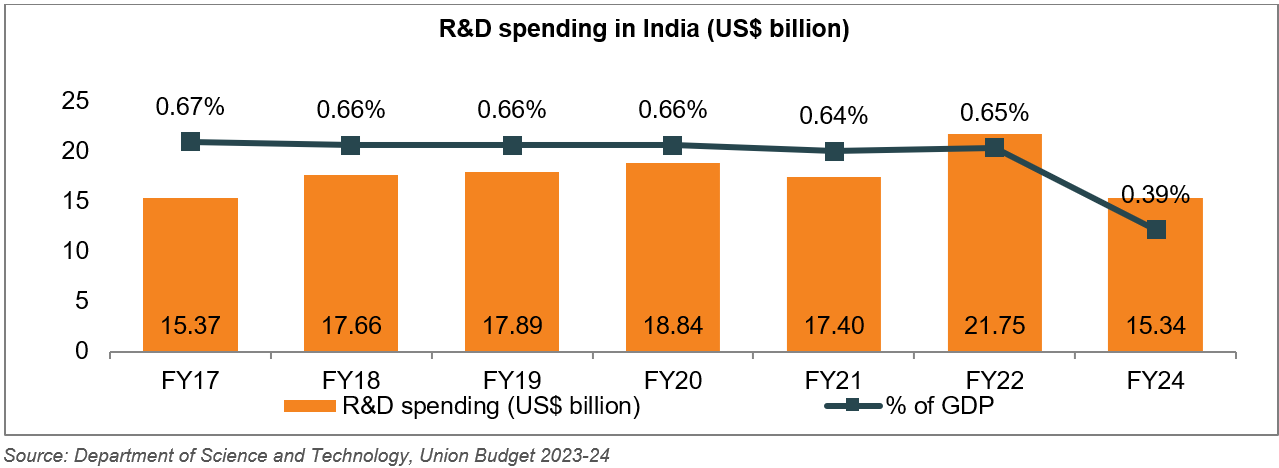
India's Research and Development (R&D) spending doubled to US$ 15.34 billion in FY24 from US$ 9.95 billion in FY14, while technology revenue reached US$ 315 billion in FY26. With 5.80 million Science, Technology, Engineering and Mathematics (STEM) professionals and the world's third-largest startup ecosystem, India ranked 38th in the Global Innovation Index 2025, backed by a Rs. 1,00,000 crore (US$ 11.32 billion) Research, Development and Innovation Scheme.

R&D Spending (FY24)
US$ 15.34 Billion

Technology Revenue (FY26)
US$ 315 Billion

RDI Scheme Outlay
US$ 11.32 Billion

Global Innovation Index Rank (2025)
38th
Introduction
India's science and technology sector spans information technology and the digital economy, space technology, semiconductors, biotechnology and pharmaceutical research, and artificial intelligence (AI), supported by a wide network of government departments and research bodies, including the Department of Science and Technology (DST), the Ministry of Electronics and Information Technology (MeitY), the Department of Biotechnology (DBT), the Defence Research and Development Organisation (DRDO) and the Indian Space Research Organisation (ISRO).
The sector's policy framework has evolved steadily, from the Science, Technology and Innovation Policy 2020 through the National Science, Technology and Innovation Policy 2022 (STIP 2022), which aims to place India among the top five nations for research quality by 2030, to the Research, Development and Innovation (RDI) Scheme launched in July 2025 to boost private sector-led R&D under Atmanirbhar Bharat.
India ranks among the top three countries globally in scientific publications, PhD output, and the size of its start-up ecosystem. Sustained government funding, rising private investment and deepening global collaborations continue to position India as a rising hub for innovation, positioning the sector as central to the country's ambition of becoming a US$ 7 trillion economy by 2030.

MARKET SIZE AND GROWTH
- India's Research and Development (R&D) spending doubled to Rs. 1,27,000 crore (US$ 15.34 billion) in FY24, from Rs. 60,196 crore (US$ 9.95 billion) in FY14, driven by initiatives such as DISHA and the Anusandhan National Research Foundation (ANRF) across AI, biotech, space and nuclear sectors.
- India's technology revenue is projected to reach US$ 315 billion in FY26, up from US$ 283 billion in FY25, reflecting 11.31% annual growth; the sector is poised to contribute US$ 1 trillion to Gross Domestic Product (GDP) by 2030.
- India's Global Capability Centre (GCC) ecosystem comprises over 1,800 centres employing 1.90 million professionals, with the market projected to reach Rs. 9,46,330 crore (US$ 110 billion) by 2030.
- The engineering R&D and product development market is forecast to grow at a Compound Annual Growth Rate (CAGR) of 10.14%, from US$ 133.71 billion in 2025 to US$ 238.63 billion by 2031.
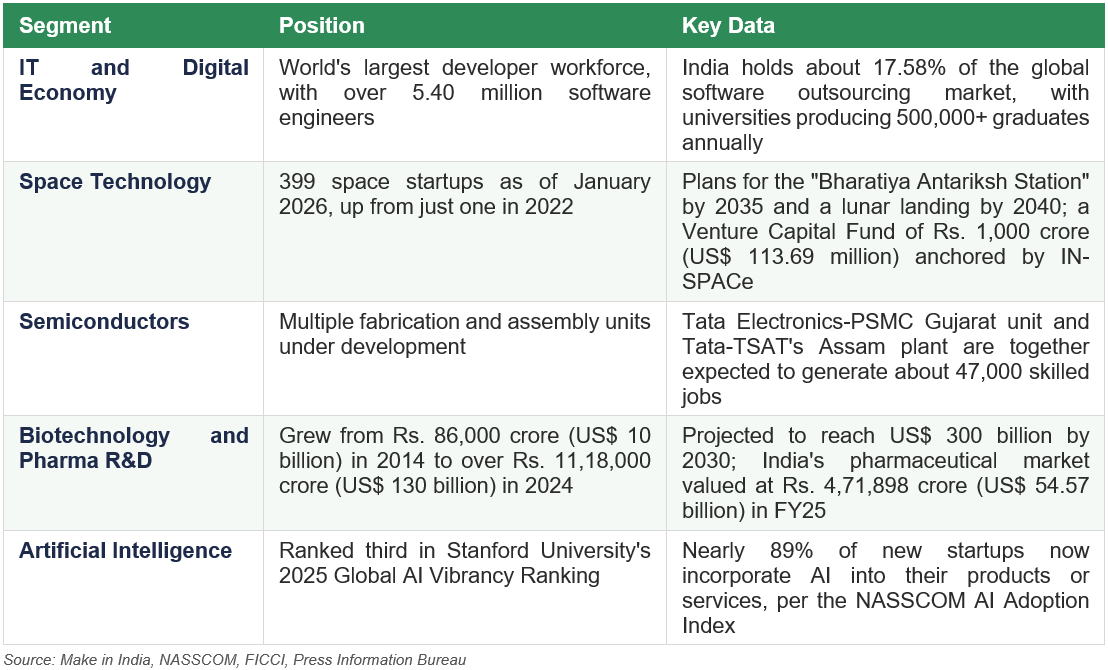
- India's Artificial Intelligence (AI) market is expected to grow to US$ 131.31 billion by 2032, at a CAGR of 42.20%, with India ranking third in Stanford University's 2025 Global AI Vibrancy Ranking.
KEY SEGMENTS
INVESTMENTS AND FDI
- The Research, Development and Innovation (RDI) Scheme, launched on July 1, 2025, with an outlay of Rs. 1,00,000 crore (US$ 11.32 billion) supports strategic technologies through long-term financing via ANRF and designated Second-Level Fund Managers.
- Tata Electronics, with Powerchip Semiconductor Manufacturing Corp (Taiwan), is setting up a Rs. 91,526 crore (US$ 10.41 billion) semiconductor facility in Gujarat, while NXP Semiconductors plans to invest more than Rs. 8,300 crore (US$ 1 billion) in India to boost its R&D efforts.
- Google announced a US$ 15 billion investment between 2026 and 2030 for an AI hub and data centre in Visakhapatnam, its largest commitment in India to date.
- Tata Group plans to invest US$ 11 billion to develop an Innovation City near the new Navi Mumbai International Airport, while Adani announced plans to invest US$ 100 billion in AI data centres over the next decade.
- Deeptech investments in India doubled to Rs. 2,800 crore (US$ 324 million) in the first four months of 2025, driven by rising commercial use cases and government-backed initiatives.
GOVERNMENT INITIATIVES
- RDI Scheme: India's largest-ever R&D funding programme, launched in July 2025 to boost private sector-led research under Atmanirbhar Bharat.
- National Quantum Mission (NQM): A Rs. 6,003.65 crore (US$ 726 million) mission spanning 2023-24 to 2030-31, fostering R&D across quantum computing, communication, sensing and materials.
- IndiaAI Mission: Allocated Rs. 1,000 crore (US$ 113.16 million) in 2026-27 to expand access to computing power and AI applications in healthcare, agriculture and climate.
- Anusandhan National Research Foundation (ANRF): Targets Rs. 50,000 crore (US$ 6.36 billion) in funding over 2023-28 to strengthen India's research ecosystem.
- India Semiconductor Mission: Allocated 37% of MeitY's budget in 2026-27, with 10 approved projects worth Rs. 1.60 lakh crore (US$ 18.50 billion) across six states.
- NM-ICPS: An outlay of Rs. 3,660 crore (US$ 507.28 million) supporting 25 Technology Innovation Hubs in AI, robotics and IoT.
- Atal Innovation Mission (AIM): Extended until March 2028 with a budget allocation of Rs. 2,750 crore (US$ 318.03 million).
- Biopharma SHAKTI Scheme: A five-year, Rs. 10,000 crore (US$ 1.13 billion) outlay to promote domestic production of biologics and biosimilars.
DRIVERS AND OPPORTUNITIES
- Large STEM talent pool - India's Science, Technology, Engineering and Mathematics (STEM) workforce ranks among the largest globally, anchoring the country's R&D and innovation ecosystem.
- Thriving startup ecosystem - India is the world's third-largest startup ecosystem, with over 1.80 lakh Department for Promotion of Industry and Internal Trade (DPIIT)-recognised startups, including more than 3,600 deep-tech ventures.
- Rising intellectual property activity - IP filings rose 44% over the past five years, with patent filings up 180%, reflecting growing homegrown innovation.
- Sustained government policy support - Initiatives such as the RDI Scheme, STIP 2022 and sector-specific tax incentives continue to strengthen India's R&D ecosystem.
- Deepening global collaboration - India has Science, Technology and Innovation (STI) cooperation agreements with 83 countries, including expanding partnerships with Japan and the UK on AI, 6G and space technology.
- Global MNC investment - Companies including Google, Micron, Toyota and Lam Research continue to expand R&D and manufacturing footprints across AI, semiconductors and automotive technology.
STRATEGIES
- AI partnership expansion - Tata Consultancy Services (TCS) has forged strategic partnerships with Anthropic, Mistral and NVIDIA to scale enterprise AI adoption and establish dedicated AI business units.
- Biosimilar portfolio expansion - Biocon continues to expand its global biosimilar footprint, securing regulatory approvals and commercial launches for products such as denosumab and semaglutide across the US, Canada and other developed markets.
- Indigenous defence platform development - Hindustan Aeronautics Limited (HAL) is deepening international collaboration, including component manufacturing agreements with Safran Aircraft Engines, alongside continued delivery of indigenous helicopter platforms.
M&A
- In June 2026, Tata Consultancy Services announced a global strategic partnership with Anthropic, establishing a dedicated business unit for enterprise AI adoption using Claude models.
- On January 31, 2025, Biocon Limited completed the Rs. 555 crore (US$ 64.10 million) acquisition of a 1.50% stake in Biocon Biologics Limited, raising its total holding to 90.20%.
- Micron Technology inaugurated India's first semiconductor Assembly, Testing, Marking and Packaging (ATMP) facility, backed by a US$ 2.75 billion investment.
- CG Power and Industrial Solutions is establishing a Gujarat semiconductor facility as a joint venture with Renesas Electronics (Japan) and STARS Microelectronics (Thailand), worth Rs. 7,584 crore (US$ 862.21 million).
TRENDS
- AI-driven transformation - The IndiaAI Mission is expanding access to computing power and AI applications across healthcare, agriculture and climate, with 87% of enterprises now actively deploying AI solutions.
- Semiconductor manufacturing push - Multiple fabrication and assembly facilities are under development across Gujarat, Assam and Uttar Pradesh, backed by the India Semiconductor Mission.
- Space economy expansion - ISRO successfully tested the Gaganyaan Service Module Propulsion System in July 2025, validating key systems for India's first human spaceflight mission.
- Deeptech investment surge - Deeptech funding doubled year-on-year in early 2025, driven by growing commercial use cases in AI, quantum computing and biotechnology.
RECENT DEVELOPMENTS
- July 2026 : Tata Consultancy Services launched its Autonomous Engineering Lab, powered by NVIDIA, at its Bengaluru campus, supporting AI deployment in mobility and manufacturing.
- June 2026 : Tata Consultancy Services strengthened its collaboration with Oracle by launching India's first Oracle AI Data Platform Lab and Centre of Excellence in Kolkata.
- April 2026 : Hindustan Aeronautics Limited delivered four ALH Mk III Maritime Role helicopters to the Indian Coast Guard in Bengaluru.
- February 2026 : Biocon received U.S. FDA approval for its complex formulation, Liraglutide Injection (gSaxenda).
- May 2025 : The Union Cabinet approved a sixth semiconductor unit by HCL and Foxconn near Jewar, Uttar Pradesh, with a Rs. 3,700 crore (US$ 432.90 million) investment.
- February 2025 : Lam Research announced plans to invest over US$ 1.20 billion in Karnataka to strengthen India's semiconductor ecosystem.
FAQs
The Science and Technology in India ecosystem encompasses research & development (R&D), biotechnology, space, artificial intelligence, semiconductors, quantum technologies, and digital innovation. It plays a pivotal role in advancing industrial competitiveness, innovation, and economic growth.
Science and Technology in India drives innovation, productivity, and high-value employment across industries. It supports manufacturing, digital transformation, startups, and global R&D investments, strengthening India's position as a leading technology and innovation hub.
The Science and Technology Industry in India has witnessed major advances in AI, semiconductors, space exploration, quantum technologies, biotechnology, and supercomputing. Rising patent filings, startup growth, and global R&D investments continue to strengthen the innovation ecosystem.
The Science and Technology in India ecosystem is expanding due to higher R&D spending, a strong STEM talent pool, digital transformation, startup growth, AI adoption, and increasing public and private investments in emerging technologies.
Rising R&D investments are strengthening the Science and Technology Industry in India by accelerating innovation in AI, semiconductors, biotechnology, defence, and space technologies. Increased patent filings and industry-academia collaboration are also driving indigenous innovation.
The Government is promoting Science and Technology in India through initiatives such as the IndiaAI Mission, National Quantum Mission, Atal Innovation Mission, India Semiconductor Mission, ANRF, and the Vigyan Dhara scheme to strengthen research and innovation.
The Science and Technology Industry in India offers investment opportunities across AI, semiconductors, biotechnology, space technology, data centres, quantum computing, and deep-tech startups. Strong policy support and rising FDI continue to attract global investors.
Emerging technologies such as AI, quantum computing, semiconductors, biotechnology, robotics, and space technologies are transforming the Science and Technology Industry in India by improving productivity, accelerating innovation, and creating new business opportunities across sectors.
The future of Science and Technology in India remains strong, supported by growing R&D investments, international collaborations, emerging technologies, and government-led innovation programmes. These developments are expected to strengthen India's position as a global technology and innovation hub.
Related News
MOREMajor Indian States for Science and Technology
- Maharashtra
- Gujarat
- NCR
- Karnataka
- Tamil Nadu
- Telangana
- Andhra Pradesh
- Madhya Pradesh


IBEF Campaigns
MORE

Case Studies
MOREHow Indian Pharmaceutical Companies Are Strengthening Their Position in Global Markets

India has become a key player in the pharmaceutical industry of the world, which can be described in terms of the following factors: large-scale manuf...
Containerisation: Transforming India's Maritime Trade

Despite other modes of transportation, the maritime shipping mode is the backbone of international trade. The concept of containerisation has revoluti...
India’s Growing Senior Care Needs: New Businesses and Services

The current state of India is characterised by the process of demographic transition with gradual growth of the proportion of senior citizens within t...
IBEF BLOG
MORE
Semiconductor Equipment and Materials: Strengthening India's Position in the Global Chip Supply Chain
The semiconductor manufacturing strategy in India is getting more comprehen...

India's Deep-Tech Startup Wave: Beyond Fintech and E-commerce
The Indian start-up eco-system, traditionally known for its focus on digita...

Investment Opportunities in India: Sectors With Strong Growth Potential
India has emerged as a potential investment destination owing to its econom...
Partners