EXECUTIVE SUMMARY
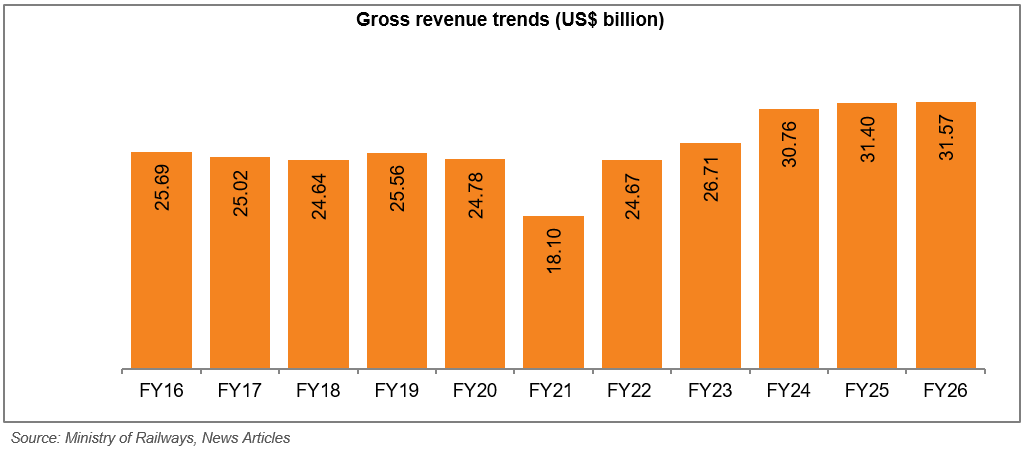
India has the world's fourth-largest railway network, with gross revenue reaching US$ 31.57 billion in FY26. Freight loading crossed 1,700 million tonnes and passenger traffic reached 738 crore, while Indian Railways was allocated a record capital expenditure of US$ 33.16 billion in the Union Budget 2026-27.

Gross Revenue (FY26)
US$ 31.57 Billion

Freight Loading (FY26)
1,700 MT

Passenger Traffic (FY26)
738 Crore

Route Network (FY25)
69,439 km
Introduction
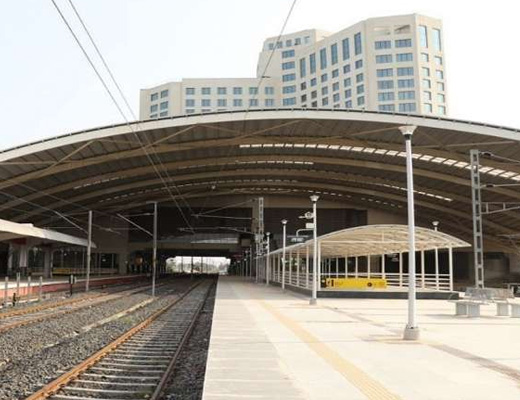
Indian Railways is a departmental undertaking of the Government of India, overseen by the Ministry of Railways, and owns and operates most of the country's rail transport. It is the world's fourth-largest railway network after the United States, Russia and China, with an extensive route network spanning the length of the country. The network is organised around two major segments, freight and passenger transport, supplemented by a growing metro and urban rail ecosystem and an expanding Dedicated Freight Corridor system.
Indian Railways operated 76,352 special trains in FY26, with about 25,000 trains running daily across the network. As of March 2025, it operated more than 13,000 passenger trains, including 4,111 Mail and Express trains, 3,313 Passenger trains, and 5,774 Suburban trains, alongside an extensive freight wagon fleet of approximately 427,000 wagons.
The sector is a critical driver of India's economy, moving both industrial freight and mass passenger traffic while anchoring national logistics and connectivity. Sustained government capital expenditure, expanding electrification, and growing private-sector participation through Public-Private Partnership (PPP) models continue to modernise the network, positioning Indian Railways as a key enabler of India's infrastructure and economic growth.
MARKET SIZE AND GROWTH
- Indian Railways' gross revenue reached Rs. 2.79 trillion (US$ 31.57 billion) in FY26, up from Rs. 2.87 trillion (US$ 31.40 billion) in FY25, and is expected to reach Rs. 3.02 trillion (US$ 31.96 billion) in FY27 per the Union Budget.
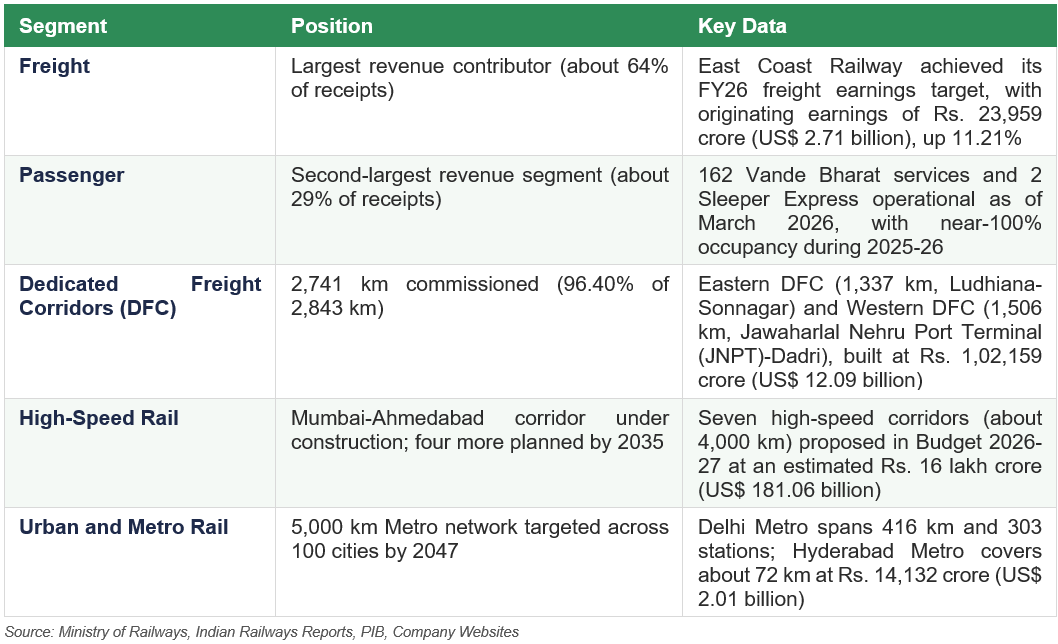
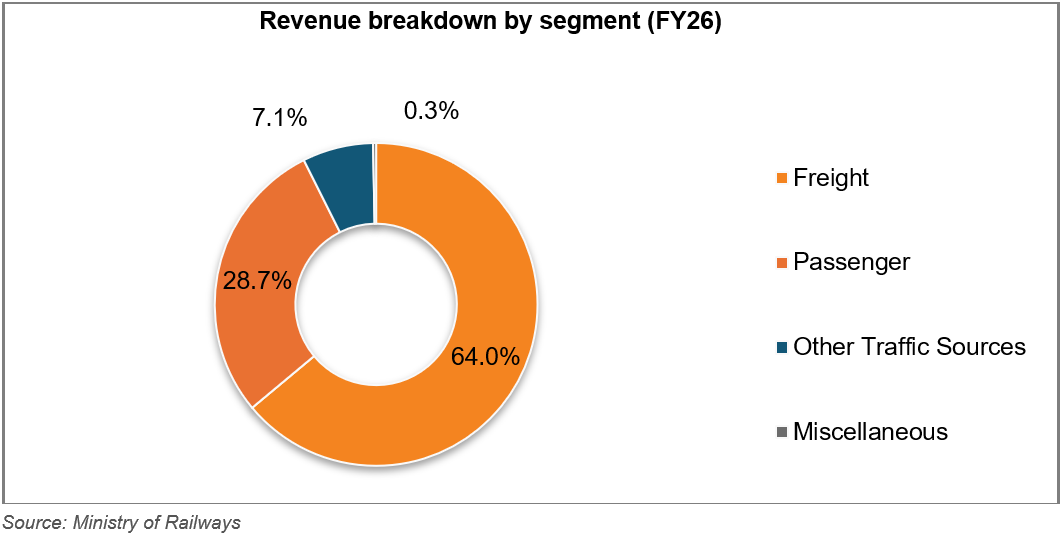
- Freight revenue, the largest contributor at about 64% of total receipts, rose to Rs. 1,78,457 crore (US$ 20.19 billion) in FY26 from Rs. 1,71,163 crore (US$ 19.79 billion) in FY25, and is expected to reach Rs. 1,88,800 crore (US$ 20.00 billion) in FY27.
- Passenger revenue rose 6.15% to Rs. 80,000 crore (US$ 9.05 billion) in FY26 from Rs. 75,368 crore (US$ 8.72 billion) in FY25, and is expected to reach Rs. 87,300 crore (US$ 9.25 billion) in FY27.
- Freight loading increased 5.27% to 1,700 million tonnes (MT) in FY26 from 1,614.90 MT in FY25, a Compound Annual Growth Rate (CAGR) of 4.88% since FY17, and reached 419.08 MT in Q1 FY27. Passenger traffic rose 1.23% to 738 crore in FY26 from 729 crore in FY25, reaching 63.81 crore in Q1 FY27.
- Indian Railways was allocated a record capital expenditure of Rs. 2,93,030 crore (US$ 33.16 billion) under the Union Budget 2026-27.
KEY SEGMENTS
INVESTMENTS AND FDI
- Foreign Direct Investment (FDI) inflows in railway-related components stood at Rs. 9,344.43 crore (US$ 1.45 billion) cumulatively between April 2000 and March 2026.
- Rail infrastructure is projected to attract Rs. 50 lakh crore (US$ 526.48 billion) in investment by 2030.
- Indian Railways plans to invest Rs. 16,70,000 crore (US$ 193.98 billion) by 2031 to modernise 1,309 stations, expand freight corridors, develop high-speed rail projects and electrify tracks.
- Public-Private Partnership (PPP) projects worth Rs. 166.90 billion (US$ 1.89 billion) have been completed, with a further seven projects worth Rs. 163.60 billion (US$ 1.85 billion) under implementation; PPP-led mineral and coal transport corridors are projected to draw over Rs. 5.25 lakh crore (US$ 60.43 billion) by 2031.
- India's freight wagon market is expected to nearly double by 2031, to about Rs. 25,000-30,000 crore (US$ 2.83-3.40 billion), driven by exports, technology upgrades and large-scale procurement.
GOVERNMENT INITIATIVES
- Union Budget 2026-27: Allocated a record capital expenditure to modernise rail infrastructure, expand network capacity and strengthen freight and passenger connectivity.
- 100% FDI: Permitted under the automatic route for approved rail projects, including suburban corridor operation and maintenance through PPP.
- RailTech Policy and Portal: Promotes startup-led technology adoption and has digitised the Railway Claims Tribunal for online filing and hearings under the “52 Reforms in 52 Weeks” initiative.
- National Rail Plan (Vision 2024): Targets 100% electrification, speed upgrades on key routes and elimination of level crossings on golden quadrilateral-diagonal routes.
- Kavach: India's indigenous train-collision-avoidance system; 1,306 route km commissioned as of January 2026, with 2,000 km targeted for coverage.
- Rashtriya Rail Sanraksha Kosh: A dedicated safety fund with a corpus of Rs. 1 lakh crore (US$ 15.61 billion) over five years.
- Amrit Bharat Station Scheme: 1,337 stations redeveloped to date; foundation laid for 508 more stations across 27 states and union territories at a cost of over Rs. 24,470 crore (US$ 2.95 billion).
- Net Zero by 2030: A Memorandum of Understanding (MoU) with USAID/India, signed June 2023, supports Indian Railways' goal of net-zero carbon emissions by 2030.
DRIVERS AND OPPORTUNITIES
- Rising incomes and urbanisation - India's urban population rose from 461 million in 2018 to 522 million in 2025, from 33.50% to 35.69% of the total population, making rail travel increasingly affordable and accessible.
- Industrial freight demand - Strong growth in fertilisers (up 13.45%), pig iron and steel (up 17.98%) and containers (up 11.32%) is driving sustained freight volume growth.
- Government infrastructure focus - Sustained capital expenditure, Dedicated Freight Corridor expansion and High-Speed Rail development continue to anchor long-term network growth.
- Private sector participation - PPP frameworks such as R3i and R2CI, alongside a broader participative policy, are drawing private capital into rail connectivity and terminal infrastructure.
- Global export potential - Indian Railways now exports coaches, bogies, locomotives and propulsion systems to more than 16 countries, and India is projected to account for 40% of global rail activity by 2050.
- Safety and modernisation - Kavach rollout, near-complete electrification and improved punctuality (80% in FY26) are strengthening service reliability.
STRATEGIES
- Network and technology partnerships - Delhi Metro Rail Corporation (DMRC) is deepening collaborations with technology and manufacturing partners, including a rolling-stock joint bidding partnership with BEML and the use of Artificial Intelligence (AI) to improve operational efficiency and passenger safety.
- Diversified turnkey construction - IRCON International has completed more than 400 infrastructure projects in India and over 130 projects across 25-plus countries, spanning railway and highway construction, electrification and metro systems.
- Phased network expansion - Hyderabad Metro Rail Limited (HMRL) continues to expand its network in phases while layering in passenger-safety and smart-mobility features such as automated parking and women-focused transit initiatives.
M&A
- Madhepura Electric Locomotive Pvt Ltd (MELPL), a joint venture between Indian Railways and France's Alstom, has supplied 576 high-power electric locomotives with over 90% indigenous sourcing, against a contracted total of 800.
- The Marhowra Diesel Locomotive Factory, developed under a PPP model, has delivered 773 locomotives and secured export orders worth US$ 400 million for 150 locomotives to Guinea's Simandou iron ore project, a deal valued at Rs. 3,000 crore (US$ 345.90 million).
- In April 2026, DMRC and BEML signed an MoU to jointly identify, bid for and execute metro rail projects in India and international markets.
- In October 2025, IRCON signed a non-binding MoU with Coal India Limited to collaborate on rail infrastructure development for Coal India and its subsidiaries.
TRENDS
- High-speed rail momentum - The Mumbai-Ahmedabad High-Speed Rail corridor has entered its final pre-commissioning phase for the Surat-Bilimora section, with 100% land acquisition complete across Maharashtra and Gujarat, while Andhra Pradesh has proposed a South India bullet train corridor linking Hyderabad, Chennai, Amaravati and Bengaluru.
- Digital ticketing and passenger technology - The RailOne app, launched July 1, 2025, offers unified unreserved ticketing and live train tracking, while the Unreserved Ticketing System (UTS) app now covers 9,120 stations with about 2.34 lakh tickets booked daily.
- Green and net-zero push - Indian Railways has commissioned 898 MW of solar power across its network, and the Rs. 1,800 crore (US$ 209.10 million) “Brahma” rail coach hub near Bhopal is being built as a zero-liquid-waste green factory.
- Semi-high-speed and premium travel - Indian Railways plans to manufacture 260 Vande Bharat sleeper trainsets, and over 21,800 track km are now fit for semi-high-speed trains running at 130 kmph.
RECENT DEVELOPMENTS
- July 2026 : DMRC commenced construction of the Inderlok-Indraprastha corridor, beginning with a diaphragm wall at the Sarai Rohilla Metro Station site.
- June 2026 : DMRC received the Achievement Award in the Operational Excellence category from the International Association of Public Transport (UITP).
- May 2026 : The Telangana Government secured up to Rs. 13,600 crore (US$ 1.43 billion) in refinancing support for Hyderabad Metro Rail.
- February 2026 : The Union Cabinet approved three multi-tracking projects worth Rs. 9,072 crore (US$ 990.34 million) across Maharashtra, Madhya Pradesh, Bihar and Jharkhand.
- December 2025 : The Union Cabinet approved three new corridors spanning 16.08 km under Delhi Metro's Phase V(A) project, at an estimated cost of Rs. 12,014.91 crore.
- October 2025 : IRCON signed a non-binding MoU with Coal India Limited to collaborate on rail infrastructure development.
FAQs
The Indian Railways Industry is one of the world's largest railway networks under single management, comprising passenger, freight, high-speed rail, rolling stock manufacturing, station infrastructure, and logistics. It serves as the backbone of India's transportation system and industrial supply chains.
The Railway industry supports economic growth by transporting over 738 crore passengers and 1,700 million tonnes of freight in FY26 and reached 63.81 crore passengers and 419.08 million tonnes of freight in Q1 FY27. It lowers logistics costs, improves connectivity, supports manufacturing, and strengthens domestic and international trade across India.
The Indian Railways Industry comprises passenger transportation, freight logistics, high-speed rail, metro connectivity, railway infrastructure, rolling stock manufacturing, signalling systems, station redevelopment, and export-oriented rail equipment manufacturing. These segments collectively support India's transport and logistics ecosystem.
The Railway industry is expanding due to record capital expenditure, dedicated freight corridors, Vande Bharat trains, network electrification, AI-enabled safety systems, station redevelopment, and increasing investments in high-speed rail and multimodal logistics infrastructure.
The Indian Railways Industry is being modernised through Vande Bharat and Bullet Train projects, Kavach train protection, 99.6% broad-gauge electrification, hydrogen-powered trains, AI-based safety systems, and the redevelopment of over 1,300 railway stations.
The Government is strengthening the Indian Railways Industry through the National Rail Plan, PM Gati Shakti, Amrit Bharat Station Scheme, Rail Tech Policy, Dedicated Freight Corridors (DFC), PPP projects, Kavach, and a record Union Budget FY27 capital outlay of US$ 33.16 billion.
The Railway industry offers investment opportunities across rolling stock manufacturing, station redevelopment, freight corridors, high-speed rail, signalling, electrification, logistics parks, railway technology, and PPP projects. Rising FDI and export opportunities continue to strengthen investor interest.
The Railway industry continues to focus on expanding network capacity, reducing congestion, modernising ageing infrastructure, and integrating advanced technologies. Ongoing investments in digitalisation, AI-enabled safety, and dedicated freight corridors are helping address these long-term challenges.
Indian Railways is India's largest mass transport network, carrying 738 crore passengers and a record 1,700 million tonnes of freight in FY26 and reached 63.81 crore passengers and 419.08 million tonnes of freight in Q1 FY27. Dedicated freight corridors, Vande Bharat services, and improved punctuality are enhancing both logistics efficiency and passenger experience.
The Indian Railways Industry is expected to witness sustained growth, supported by US$ 193.98 billion planned investments by 2031, high-speed rail corridors, Vande Bharat sleeper trains, railway exports, green mobility, and the goal of achieving Net Zero carbon emissions by 2030.
Related News
MOREIndian Railways

Industry Contacts

IBEF Campaigns
MORE

Case Studies
MOREHow Indian Pharmaceutical Companies Are Strengthening Their Position in Global Markets

India has become a key player in the pharmaceutical industry of the world, which can be described in terms of the following factors: large-scale manuf...
Containerisation: Transforming India's Maritime Trade
Despite other modes of transportation, the maritime shipping mode is the backbone of international trade. The concept of containerisation has revoluti...
India’s Growing Senior Care Needs: New Businesses and Services

The current state of India is characterised by the process of demographic transition with gradual growth of the proportion of senior citizens within t...
IBEF BLOG
MORE
Semiconductor Equipment and Materials: Strengthening India's Position in the Global Chip Supply Chain
The semiconductor manufacturing strategy in India is getting more comprehen...

India's Deep-Tech Startup Wave: Beyond Fintech and E-commerce
The Indian start-up eco-system, traditionally known for its focus on digita...
Investment Opportunities in India: Sectors With Strong Growth Potential
India has emerged as a potential investment destination owing to its econom...
Partners