EXECUTIVE SUMMARY
India's retail market was valued at US$ 1,094 billion in 2025 and is on track to exceed US$ 1.60 trillion by 2030. The sector contributes over 10% to Gross Domestic Product (GDP) and about 8% of the workforce, while e-commerce is projected to nearly double to US$ 333 billion by 2031.

Retail Market (2025)
US$ 1,094 billion

E-commerce Market (2026)
US$ 159.25 billion

Cumulative FDI (2001-26)
US$ 5,028.12 million

GDP Contribution
>10%
Introduction
India's retail industry spans organised and traditional trade across food and grocery, apparel and accessories, jewellery and watches, consumer durables, beauty and personal care, and e-commerce, sold through formats ranging from mono-brand and multi-brand stores to convergence outlets and online retailers. India ranks among the world's top three preferred retail destinations and is among the highest globally in per capita retail store availability.
The sector has evolved through distinct phases, from manufacturer-owned outlets before 1990, to pure-play retailers entering apparel through 2005, large Indian corporate investment and pan-India expansion through 2010, and the post-2010 wave of international brand entry alongside progressively liberalised Foreign Direct Investment (FDI) norms. Despite this evolution, more than 90% of India's retail business is still run by unorganised, traditional family-run stores, leaving organised retail at a comparatively nascent stage.
The retail sector accounts for over 10% of India's GDP and around 8% of the workforce, employing more than 35 million people and expected to create 25 million new jobs by 2030. Rising incomes, urbanisation and the rapid expansion of Tier-II and Tier-III cities continue to position India as one of the world's most attractive retail investment destinations.
MARKET SIZE AND GROWTH
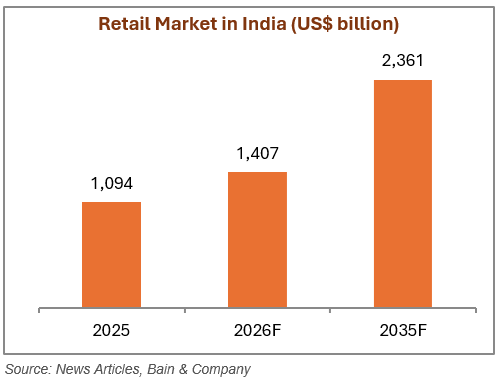
- India's retail market was valued at US$ 1,094 billion in 2025 and is projected to reach US$ 1,407 billion by 2026 and US$ 2,361 billion by 2035. By 2030, the sector is on track to exceed US$ 1.60 trillion, up from US$ 952 billion in 2024.
- India's e-commerce market was valued at US$ 159.25 billion in 2026 and is projected to reach US$ 332.94 billion by 2031. Separately, India's e-retail Gross Merchandise Value (GMV) is projected to reach US$ 170-190 billion by 2030, per Bain & Company and Flipkart.
- India's FMCG market was valued at US$ 287.91 billion in 2025 and is projected to reach US$ 1,150.21 billion by 2034, a CAGR of 16.64% during 2026-34.
- As of June 2026, India's Consumer Price Index (CPI) inflation stood at 4.38% (provisional), with rural inflation at 4.74% and urban inflation at 3.92%, while food inflation stood at 5.32%.
- India's retail sales grew 6% year-on-year in June 2026, per the Retailers Association of India (RAI), led by food and grocery at 10% growth, followed by quick-service restaurants at 9% and footwear at 8%.
KEY SEGMENTS
INVESTMENTS AND FDI
- India's retail trading sector attracted cumulative FDI of Rs. 36,740.24 crore (US$ 5,028.12 million) between April 2000 and March 2026.
- India's consumer and retail sector recorded 146 deals worth US$ 1.50 billion in Q1 2026, with deal volumes up 21% quarter-on-quarter, led by domestic consolidation and outbound activity.
- In June 2026, Amazon announced an additional US$ 13 billion investment in India to expand its artificial intelligence and cloud infrastructure, taking its total planned investment to US$ 48 billion between 2026 and 2030.
- In February 2026, Srijan Group announced an initial investment of Rs. 500 crore (US$ 59.13 million) to enter India's fashion retail sector, with plans for a further Rs. 2,000 crore (US$ 236.52 million) over the next decade.
- In July 2026, major retailers including Reliance Retail, Trent and Avenue Supermarts raised or announced plans to raise more than Rs. 4,000 crore (US$ 452.64 million) to accelerate store expansion, marking the fastest pace of physical retail expansion in four years.
GOVERNMENT INITIATIVES
- FDI Policy: 100% FDI permitted in single-brand retail under the automatic route, and 51% in multi-brand retail, subject to backend infrastructure and sourcing conditions.
- Goods and Services Tax (GST): Simplified the indirect tax structure and eliminated tax cascading, improving retailer profitability and supply chain efficiency.
- E-commerce FDI Liberalisation: The government has signalled plans to permit 100% FDI in e-commerce, building on existing retail FDI reforms.
- Income Tax Relief: The new tax regime offers a full rebate for individuals with taxable income up to Rs. 12 lakh, supporting higher disposable incomes.
- Ease of Doing Business: Streamlined registration processes for foreign companies setting up fully owned subsidiaries in India.
- Backend Infrastructure Mandate: Multi-brand retail FDI norms require at least 50% of investment in backend infrastructure such as cold storage and logistics.
DRIVERS AND OPPORTUNITIES
- Favourable demographics - By 2030, India is projected to add about 75 million middle-income and 25 million affluent households, together accounting for 56% of the population.
- Rising incomes - India's per capita GDP reached US$ 2,812.62 in FY26, with the economy ranking third globally by GDP at Purchasing Power Parity (PPP), valued at US$ 18.90 trillion.
- Changing consumer mindset - Retailers are increasingly adopting experiential flagship stores and Gen Z-focused formats, contributing to a record ~8.9 million sq. ft. of retail leasing in 2025.
- Digital payments - UPI processed over 24,161 crore transactions worth Rs. 314 lakh crore (US$ 3,553.24 billion) in FY26, accounting for about 85% of India's digital payment volume.
- Consumer credit access - Personal loans accounted for 30.70% of total bank credit in FY26, while gold loans rose 35% YoY to Rs. 1,06,00,000 crore (US$ 1.23 trillion), boosting retail spending power.
- Tier-II and Tier-III city growth - These cities are projected to add nearly 100 million new consumers to branded and organised retail by 2030.
STRATEGIES
- Cost leadership and warehousing scale - Avenue Supermarts (DMart) expanded to 452 stores by February 2026 and signed a 28-year warehouse lease with Adani Logistics in Panvel to strengthen its supply chain infrastructure.
- Premium beauty and fashion expansion - Shoppers Stop opened its 115th store at New Delhi Airport and unveiled a revamped experiential beauty and fashion store in Juhu, Mumbai, while expanding investment in its beauty retail subsidiary.
- Omnichannel integration - Reliance Retail piloted a search-and-discovery platform across its Trends and Yousta apparel formats to improve inventory visibility and order fulfilment across online and offline channels.
M&A
- In July 2026, SNITCH Apparels acquired Berrylush.
- In June 2026, Meesho Ltd. acquired 100% stakes in Kirana Club Pte. Ltd. and Retail Pulse Labs Pvt. Ltd.
- In May 2026, a consortium led by Lenexis Foodworks Pvt. Ltd. acquired a stake in Restaurant Brands Asia Ltd., the operator of Burger King India.
- In March 2026, Reliance Retail acquired the Pahadi Local and Pahadi Goodness business.
- In February 2026, Hindustan Unilever acquired a 49% stake in Zywie Ventures, while Aditya Birla Digital Fashion Ventures increased its stake in Wrogn Pvt. Ltd.
TRENDS
- Premiumisation - Mini-sized beauty products and premium brand formats are gaining traction, particularly among Gen Z consumers seeking affordable experimentation.
- Omnichannel and D2C growth - India's omnichannel business could grow five-fold to US$ 55 billion by 2027, from about US$ 11 billion currently, with Direct-to-Consumer (D2C) brands accounting for around 28% of retail leasing absorption.
- Global brand entry - Over 30 global brands entered India in 2025 across fashion, beauty and food and beverage, reflecting growing international interest in the market.
- Private label growth - About 52% of Indian consumers opted for private label products in 2025, per an EY report, with 70% saying these brands increasingly offer better quality.
- Retail 4.0 - Retailers are focusing on personalisation through an integrated offline-plus-online approach, aiming for a more agile and inclusive retail ecosystem.
RECENT DEVELOPMENTS
- January 2026 : IKEA announced plans to invest over Rs. 20,000 crore (US$ 2.20 billion) in India over five years to expand its retail network, logistics and local sourcing.
- February 2026 : Nykaa opened 11 new stores and entered four new cities in Q3 FY26, taking its total store count to 276.
- July 2026 : BlueStone announced plans to more than double its store network from 340 to 705 outlets by FY30.
- July 2026 : Ferns N Petals announced plans to expand to 350 outlets by FY28, from over 300 currently, while targeting a potential Initial Public Offering (IPO) by end-2028.
- July 2026 : lululemon announced plans to enter India through a franchise partnership with Tata CLiQ, with its first store at DLF Promenade, New Delhi.
- August 2026 : Reliance Brands partnered with global shapewear brand SKIMS to launch in India across physical and digital channels.
FAQs
India’s retail industry covers organised and traditional trade across food and grocery, apparel, jewellery, consumer durables, beauty and personal care, and e-commerce. Retail formats include mono-brand stores, multi-brand stores, convergence outlets and online retailers.
India’s retail sector contributes over 10% of GDP and around 8% of the workforce, employing more than 35 million people. The sector also supports consumption, urbanisation and employment growth across major cities and emerging Tier-II and Tier-III markets.
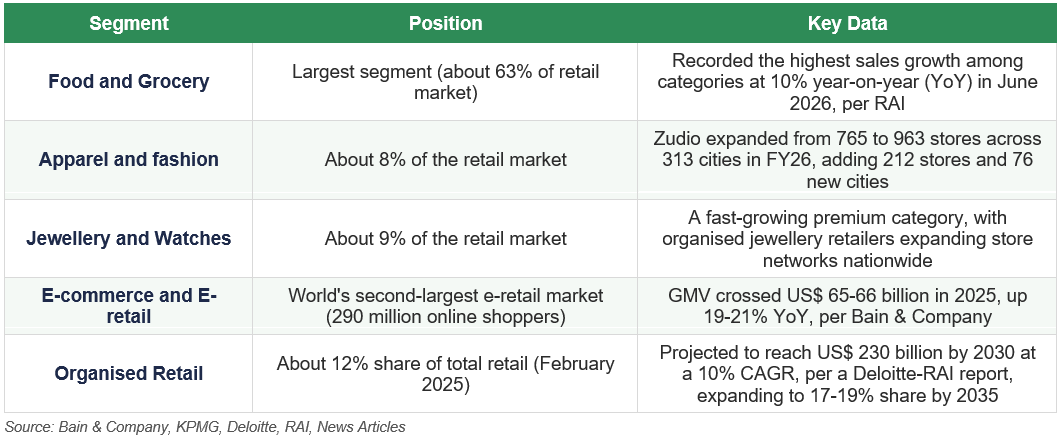
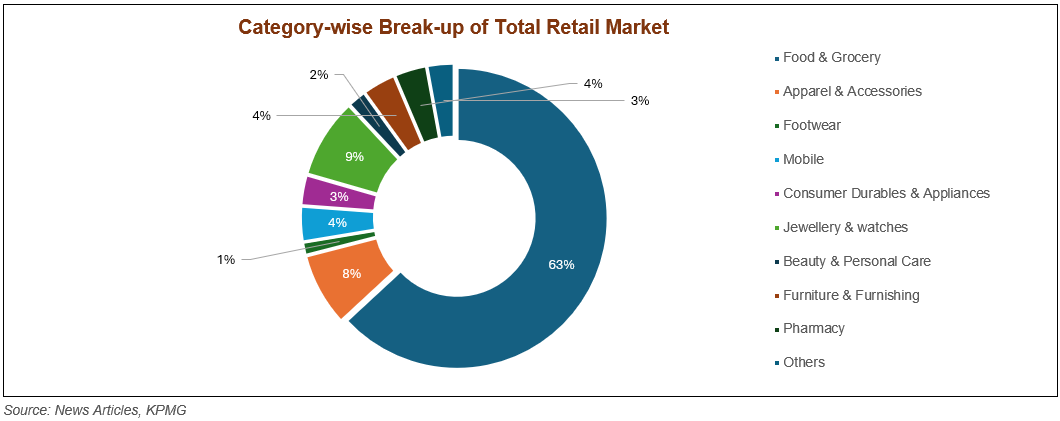
Major retail segments include food and grocery, apparel and fashion, jewellery and watches, e-commerce and e-retail, and organised retail. Food and grocery represent the largest segment, accounting for about 63% of the retail market.
Major retail segments include food and grocery, apparel and fashion, jewellery and watches, e-commerce and e-retail, and organised retail. Food and grocery represent the largest segment, accounting for about 63% of the retail market.
E-commerce is becoming a major growth engine for Indian retail, supported by rising internet penetration, digital payments and increasing online shopping adoption. India’s e-commerce market is projected to reach US$ 332.94 billion by 2031, while e-retail GMV could reach US$ 170-190 billion by 2030.
Government support includes liberalised FDI norms, measures to improve the business environment and policies that simplify registration of fully owned foreign subsidiaries. FDI is permitted up to 100% in single-brand retail and 51% in multi-brand retail under the applicable routes.
Investment opportunities include organised retail expansion, e-commerce, D2C platforms, retail infrastructure and supply-chain development. Foreign investors also benefit from India’s large consumer base, competitive labour costs, resource availability and investment-friendly policies.
Organised retail currently accounts for about 12% of total retail, leaving significant scope for further expansion. The segment is projected to reach US$ 230 billion by 2030 and increase to around 17-19% of total retail by 2035.
India’s retail market was valued at US$ 1,094 billion in 2025 and is projected to reach US$ 1,407 billion in 2026 and US$ 2,361 billion by 2035. Rising incomes, digital adoption, expanding organised retail and growth across emerging cities are expected to support further expansion.
Related News
MORERetail India

Industry Contacts

IBEF Campaigns
MORE

Case Studies
MOREHow Indian Pharmaceutical Companies Are Strengthening Their Position in Global Markets

India has become a key player in the pharmaceutical industry of the world, which can be described in terms of the following factors: large-scale manuf...
Containerisation: Transforming India's Maritime Trade
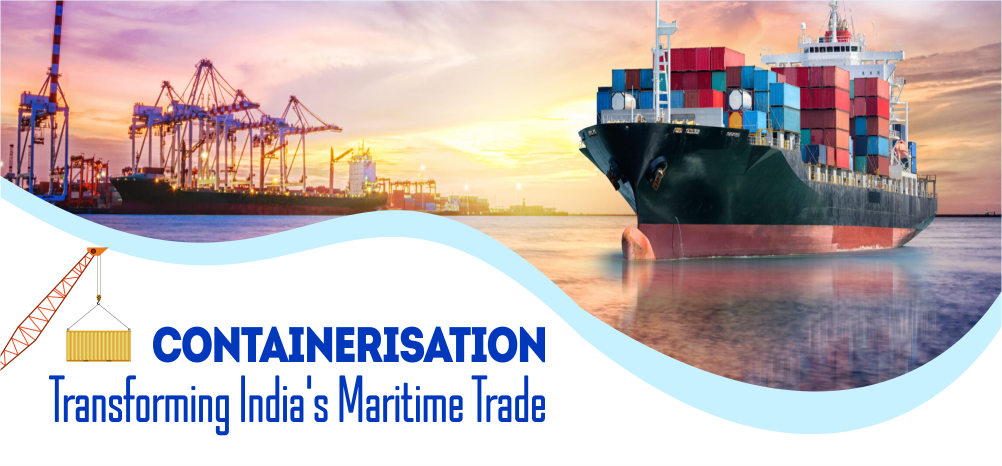
Despite other modes of transportation, the maritime shipping mode is the backbone of international trade. The concept of containerisation has revoluti...
India’s Growing Senior Care Needs: New Businesses and Services
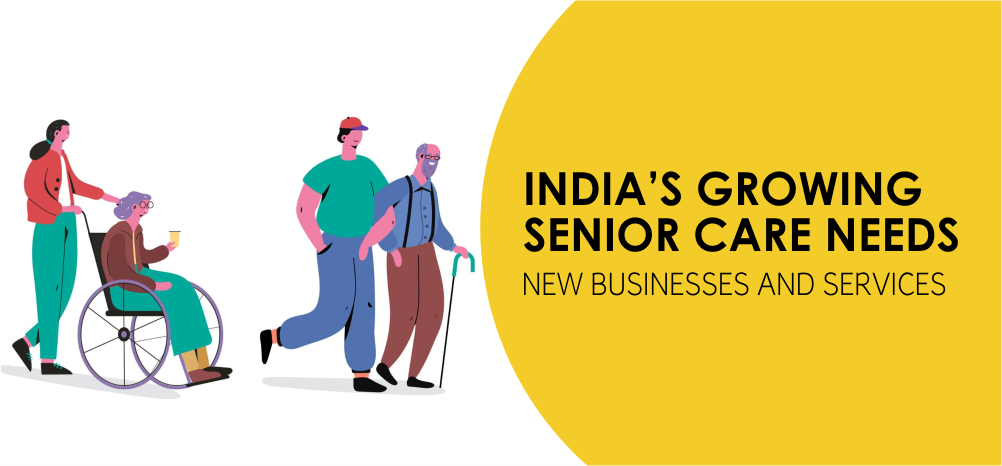
The current state of India is characterised by the process of demographic transition with gradual growth of the proportion of senior citizens within t...
IBEF BLOG
MORE
Semiconductor Equipment and Materials: Strengthening India's Position in the Global Chip Supply Chain
The semiconductor manufacturing strategy in India is getting more comprehen...

India's Deep-Tech Startup Wave: Beyond Fintech and E-commerce
The Indian start-up eco-system, traditionally known for its focus on digita...
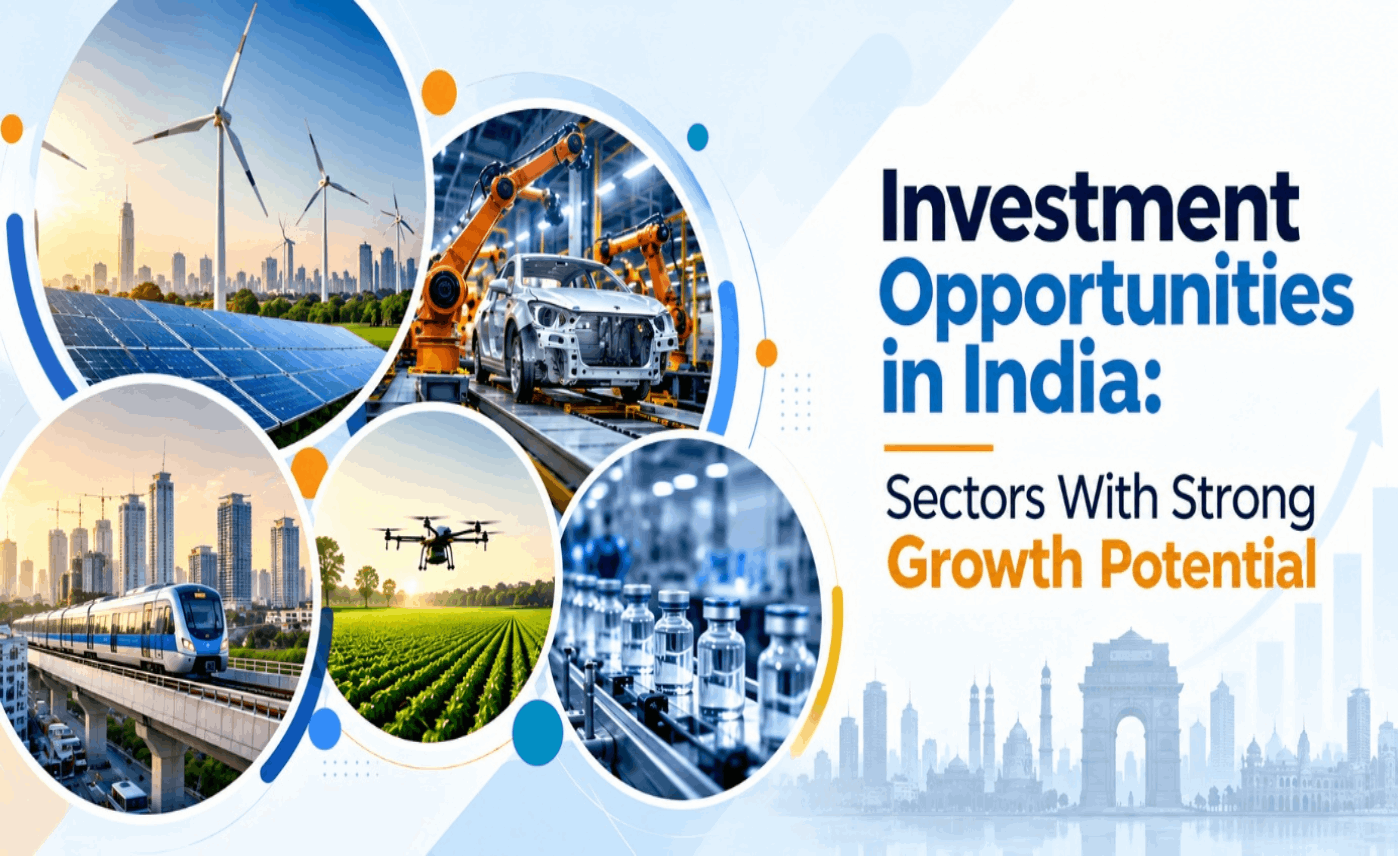
Investment Opportunities in India: Sectors With Strong Growth Potential
India has emerged as a potential investment destination owing to its econom...
Partners